



You are sitting at your desk, staring at a screen, but your mind is miles away. It is replaying a conversation from yesterday, or worrying about a deadline next week. Your body is here, but your attention is scattered across time and space. This constant mental chatter is a universal human experience, and it is a major source of stress. The practice of mindfulness offers a way out of this mental noise. It is a simple, evidence-based technique that can help you anchor yourself in the present moment, reduce anxiety, and improve your overall quality of life.
Learning what is mindfulness is the first step toward cultivating this skill. At its core, mindfulness is the ability to pay attention to what is happening right now—your thoughts, your feelings, and your physical sensations—without judging them as good or bad. It is not about emptying your mind or achieving a state of permanent bliss. It is about changing your relationship with your thoughts, so you can observe them without being swept away by them. This guide will explain the science, the benefits, and the practical steps to start practicing mindfulness today.
Important note: This article is for general information purposes only and is not a substitute for professional medical advice, diagnosis, or treatment. Mindfulness is a supportive wellness practice, not a replacement for clinical care. If you are experiencing significant mental health difficulties, always speak to your GP or a qualified mental health professional.
What Is Mindfulness? A Clear Definition
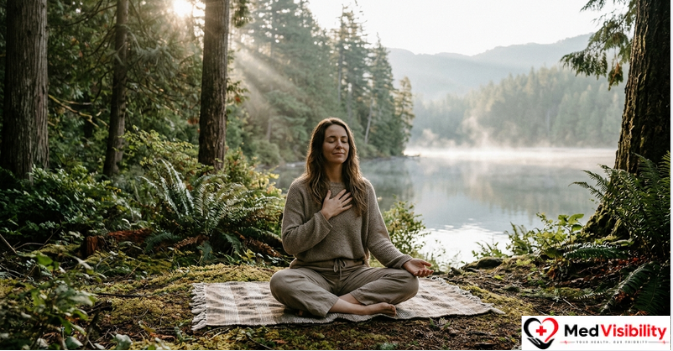
Mindfulness is often defined as “paying attention in a particular way: on purpose, in the present moment, and non-judgmentally.” This definition, popularised by Dr. Jon Kabat-Zinn, the founder of Mindfulness-Based Stress Reduction (MBSR), captures the essence of the practice. It is a quality of awareness that you can cultivate through formal meditation and informal daily activities.
The Core Components
To truly understand what is mindfulness, it helps to break it down into its three core components:
- Intention: You are deliberately choosing to pay attention to something, rather than letting your mind wander on autopilot.
- Present-Moment Awareness: Your focus is on what is happening right now, rather than dwelling on the past or worrying about the future.
- Non-Judgmental Acceptance: You observe your thoughts, feelings, and sensations without labelling them as “good” or “bad.” You simply notice them as they are.
The NHS describes mindfulness as a technique that involves paying attention to what is going on inside and outside ourselves, moment by moment. It is a way of living more in the present moment, appreciating the here and now, and not dwelling too much on the past or future.
The Science: What the Research Says
Mindfulness is not just a spiritual concept; it is a subject of rigorous scientific study. Over the past few decades, thousands of research papers have explored its effects on mental and physical health. The evidence, while still evolving, is compelling.
Mental Health Benefits
A large body of evidence supports the use of mindfulness-based interventions (MBIs) for reducing symptoms of anxiety and depression. A 2026 systematic review and meta-analysis found that mindfulness-based interventions were effective in reducing anxiety and depression among students. Another 2026 review of digital mindfulness interventions for adults also reported positive impacts on wellbeing and mental health outcomes.
In the UK, the National Institute for Health and Care Excellence (NICE) recommends mindfulness-based therapies as a way to treat less severe depression. NHS audits from Scotland have shown that mindfulness-based therapies can reduce depression by 40% and anxiety by 34%, while improving mental well-being by 32%.
Physical Health Benefits
The benefits of mindfulness extend beyond mental health. Research suggests it can also have a positive impact on physical health. Studies have shown that mindfulness can help with:
- Stress reduction: By calming the nervous system, mindfulness can lower the physiological symptoms of stress.
- Sleep quality: Mindfulness practices, particularly body scans, can help calm a racing mind before bed.
- Pain management: Mindfulness techniques are increasingly used in pain management programmes to help people change their relationship with chronic pain.
- Blood pressure: Some studies suggest that regular mindfulness practice can have a modest positive effect on blood pressure.
READ MORE: 5 Best Steps How to Meditate for Beginners
A Balanced Perspective
It is important to approach these findings with a balanced perspective. While the evidence is promising, mindfulness is not a magic cure-all. Much of the research has limitations, including small sample sizes and a lack of long-term follow-up. The NHS notes that while mindfulness can be helpful, it is not a substitute for professional treatment for serious mental health conditions. It is best viewed as a supportive practice that can complement other treatments and lifestyle changes.
Mindfulness vs. Meditation: What Is the Difference?
The terms “mindfulness” and “meditation” are often used interchangeably, but they are not the same thing. Understanding the distinction can help you build a more effective practice.
| Feature | Mindfulness | Meditation |
|---|---|---|
| What It Is | A quality of awareness; a way of living | A formal practice; a structured exercise |
| When It Happens | Anytime, during any activity | A dedicated time and place, usually sitting still |
| Core Action | Paying attention to the present moment | Focusing the mind on a specific object (e.g., breath) |
| Relationship | Mindfulness is the goal | Meditation is one of the primary tools to achieve it |
In short, meditation is a formal practice that you set aside time for. Mindfulness is the quality of awareness that you can bring to any moment of your day—whether you are meditating, washing the dishes, or walking to the shop. You can practice mindfulness without meditating, but meditation is often the most effective way to train your mind to be more mindful.
How to Practice Mindfulness: A Beginner’s Guide
The best way to learn what is mindfulness is to experience it directly. Here are two simple practices you can try.
Formal Practice: A 5-Minute Breathing Meditation
- Find a comfortable position: Sit on a chair with your feet flat on the floor, or on a cushion on the floor. Keep your back straight but not rigid.
- Set a timer: Start with just five minutes.
- Notice your breath: Close your eyes or soften your gaze. Bring your attention to the sensation of your breath entering and leaving your body.
- Notice when your mind wanders: Your mind will wander. This is normal. When you notice it has wandered, gently bring your attention back to your breath. Do not judge yourself. This is the practice.
- Be kind to yourself: The goal is not to have a perfectly blank mind. The goal is to show up and practice noticing. what is mindfulness.
Informal Practice: Mindfulness in Daily Life
You do not need to sit on a cushion to practice mindfulness. You can bring mindful awareness to any daily activity. Try this the next time you are washing your hands:
- Feel the water: Notice the temperature and the sensation of the water on your skin.
- Smell the soap: Inhale the scent. what is mindfulness.
- Feel the movement: Notice the motion of your hands rubbing together.
- Be present: If your mind wanders, gently bring your attention back to the physical sensations of washing your hands. what is mindfulness.
By practicing these small moments of mindfulness throughout the day, you can train your brain to be more present, more often. what is mindfulness.
When to See a Doctor
Mindfulness is a safe and supportive practice for most people. However, it is not a substitute for professional mental health care. what is mindfulness.
You should seek help from a GP or a qualified mental health professional if:
- You are experiencing persistent low mood, anxiety, or hopelessness.
- Your mental health is significantly affecting your daily life, work, or relationships.
- You are having thoughts of self-harm or suicide. what is mindfulness.
- You are using mindfulness as a way to avoid dealing with a serious problem.
In the UK, you can also self-refer to NHS Talking Therapies for confidential, evidence-based help with stress, anxiety, and depression. You do not need a GP referral to access this service.
FAQ’s
What is mindfulness in simple terms?
Mindfulness is the practice of paying attention to the present moment—to your thoughts, feelings, and physical sensations—without judging them. It is a way of training your mind to be more focused, calm, and aware. what is mindfulness.
What are the three core components of mindfulness?
The three core components are intention (choosing to pay attention), present-moment awareness (focusing on the here and now), and non-judgmental acceptance (observing without labelling). what is mindfulness.
Is mindfulness the same as meditation?
No. Meditation is a formal, structured practice that you set aside time for. Mindfulness is a quality of awareness that you can bring to any moment of your day. Meditation is one of the primary tools for cultivating mindfulness. what is mindfulness.
How long should I practice mindfulness each day?
For beginners, 5 to 10 minutes of formal practice a day is a great starting point. The key is consistency, not duration. As the practice becomes more natural, you can gradually extend the time. what is mindfulness.
Can mindfulness help with anxiety?
Yes, research suggests that mindfulness can be an effective tool for reducing symptoms of anxiety and stress. It can help you create a small gap between a stressful trigger and your reaction, allowing you to respond more calmly.
Do I have to be spiritual to practice mindfulness?
Not at all. While mindfulness has roots in many spiritual traditions, the secular practice of mindfulness is entirely accessible to people of any faith or none. It is a mental training technique that anyone can benefit from. what is mindfulness.
Final Thoughts
Understanding what is mindfulness is the first step toward a more grounded, peaceful life. It is not about escaping reality or achieving a state of permanent bliss. It is about changing your relationship with your thoughts so that you can observe them without being swept away by them. what is mindfulness.
The practice is simple, but it is not always easy. Your mind will wander. You will get distracted. That is okay. The most important thing is to begin. Start with five minutes a day. Bring mindful awareness to your morning coffee or your walk to work. Over time, these small moments of presence can add up to a profound shift in how you experience your life.
Medical Disclaimer: This article is provided for general information purposes only and is not intended as medical advice, diagnosis, or treatment. Always seek the advice of your doctor or other qualified health professional with any questions you may have regarding a medical condition. Never disregard professional medical advice or delay in seeking it because of something you have read online. what is mindfulness.

Other Articles

Meditation A simple, fast way to reduce stress
5 Best Steps How to Meditate on God’s Word



[…] is practically impossible). Instead, you are practicing the art of noticing when your mind has wandered off into a spiral of stressful thoughts, and gently bringing your attention back to the present […]