



A patient types “dentist near me” into their phone while sitting in a car park. Three clinics appear on the map. They tap one, read a couple of reviews, and press call all before you’ve finished reading this sentence. That’s the entire decision journey now, and if your clinic wasn’t one of the three, that patient never knew you existed.
Ranking well on Google Maps isn’t about tricking an algorithm. It’s about giving Google clear, consistent, trustworthy signals about who you are, where you are, and whether real patients trust you. This guide walks through exactly how that works, in plain English, with no fluff and no shortcuts that could backfire. how to rank my clinic on google maps.
How Google Actually Decides Which Clinics to Show
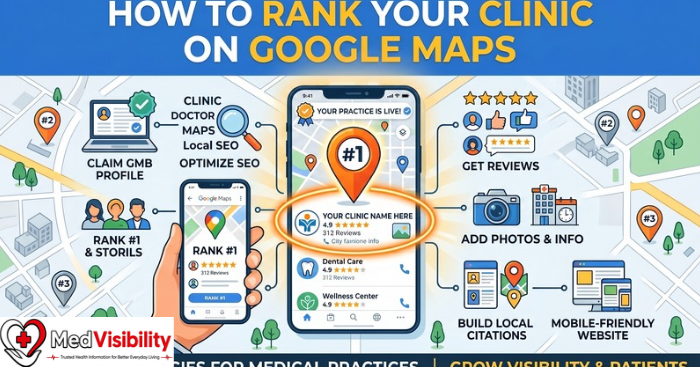
Google Maps rankings including the “Local 3-Pack” that appears above regular search results come down to three factors working together:
- Relevance — how well your profile matches what the person searched for
- Distance — how close your clinic is to the searcher (or the area they searched)
- Prominence — how well-known and well-reviewed your clinic is, both online and offline
You can’t control distance. But relevance and prominence are almost entirely in your hands, and that’s where most of this guide lives.
Step 1: Claim and Fully Complete Your Google Business Profile
Your Google Business Profile (GBP) — the listing that shows up on Maps with your hours, reviews, and photos — is the single biggest lever you have. An incomplete or unclaimed profile is the most common reason a genuinely good clinic stays invisible.
Once you’ve claimed and verified it, fill in every section, not just the basics:
- Business name (exactly as it appears on your signage — no keyword stuffing like “Smith Dental — Best Dentist London”)
- Full, accurate address and service area
- Phone number and website
- Opening hours, including holiday hours
- A clear business description explaining what you treat and who you serve
- Services and products offered, with short descriptions
- Attributes (wheelchair access, on-site parking, online booking, and so on)
An empty or sparse profile gives Google very little to work with, which usually means it plays it safe and ranks you lower. how to rank my clinic on google maps.
Choosing the Right Category
Your primary category is one of the strongest ranking signals on the entire profile. Pick the most specific one that genuinely describes your clinic — “Dermatology clinic” rather than a vague “Medical clinic,” for example. You can add several secondary categories too, but only for services you actually provide. Google can penalise profiles that use categories to chase search volume rather than reflect reality, so accuracy matters more than ambition here.
Step 2: Get Your NAP Consistent Everywhere
NAP stands for Name, Address, and Phone number. It needs to match, character for character, across your Google profile, your website, and every directory you’re listed on — NHS directory pages, health directories, local business listings, social media, everything. how to rank my clinic on google maps.
Inconsistent NAP is confusing for patients, but it’s also confusing for Google. If your address is written three different ways across the web, Google has less confidence it knows exactly where you are, and that uncertainty tends to show up as a lower ranking. This is one of those unglamorous jobs — checking old directory listings, fixing a typo on Facebook, updating a citation from years ago — that quietly makes a real difference. how to rank my clinic on google maps.
Step 3: Build Genuine Patient Reviews
Reviews influence both prominence (does Google see you as a trusted, active business) and the patient’s actual decision (would a stranger choose you over the clinic next door). A handful of five-star reviews from five years ago won’t do much; a steady, recent stream matters far more. how to rank my clinic on google maps.
A few practical, ethical ways to build this up:
- Ask happy patients directly, in person or via a follow-up text or email, with a direct link to your review page
- Time the ask for right after a positive moment — a successful appointment, a kind comment on the way out
- Respond to every review, good or bad, professionally and without getting defensive
- Never offer money, discounts, or incentives in exchange for reviews — this breaches Google’s policies and can get your listing suspended
If a review is negative, a calm, specific, non-defensive response often does more for your reputation than the review itself does damage. Prospective patients read how you handle criticism as closely as they read the criticism.
Step 4: Use Photos and Posts to Stay Active
Google favours listings that look alive. A profile with three photos from 2021 signals stagnation; a profile updated regularly signals a real, active business. how to rank my clinic on google maps.
Worth adding and refreshing over time:
- Photos of the clinic exterior and interior (so patients recognise it when they arrive)
- Photos of the team (this builds trust before a patient ever walks in)
- Photos of the waiting area, treatment rooms, and equipment where appropriate
- Regular Google Posts about new services, opening hours changes, or general updates
Keep any before-and-after or treatment imagery tasteful, accurate, and compliant with relevant advertising and healthcare marketing standards for your specialty and location.
Step 5: Strengthen Your Website’s Local Signals
Your Google Business Profile does a lot of the heavy lifting, but your website still matters, both to Google and to patients who click through for more detail. how to rank my clinic on google maps.
A few things worth checking:
- Include your clinic’s name, address, and phone number clearly on the site, ideally in the footer of every page
- Create a dedicated page for each location if you have more than one clinic, rather than one generic page trying to cover them all
- Use natural, location-specific language in page titles and headings — “Physiotherapy Clinic in Manchester” reads more naturally to both patients and Google than a page stuffed with keyword variations
- Embed a Google Map on your contact page
- Make sure the site loads quickly and works well on a phone, since most local searches happen on mobile
Step 6: Build Local Citations and Backlinks
A citation is any mention of your clinic’s name, address, and phone number on another website — a directory, a local news article, a chamber of commerce listing. Backlinks are links pointing to your website from other sites. Both act as votes of confidence that tell Google your clinic is a real, established part of the local area.
Useful places to build these, depending on your country and specialty:
- General business directories (Google, Bing Places, Apple Maps, Yelp)
- Health-specific directories relevant to your field
- Local news sites, community boards, or sponsorships
- Partnerships with nearby complementary practices (a dentist and an orthodontist referring patients to each other, for instance)
Quality matters far more than quantity here. A handful of citations from genuinely relevant, well-known sites will do more for you than dozens from low-quality directories nobody visits. how to rank my clinic on google maps.
Common Mistakes That Quietly Hurt Your Ranking
| Mistake | Why It Hurts | Simple Fix |
|---|---|---|
| Keyword-stuffed business name | Violates Google’s guidelines and can trigger a suspension | Use your real, legal business name only |
| Multiple listings for one clinic | Splits your reviews and confuses Google | Merge duplicate listings via Google Business Profile support |
| Inconsistent address across the web | Reduces Google’s confidence in your location | Audit and correct NAP on every directory |
| Ignoring negative reviews | Looks unresponsive to prospective patients | Reply calmly and professionally to every review |
| Stale or missing photos | Signals an inactive, low-trust profile | Add fresh photos every few months |
| Wrong or overly broad category | Reduces relevance for the searches that matter | Choose the most specific accurate category |
Realistic Expectations: What Google Maps SEO Can and Can’t Do
It’s worth being honest about limitations here, because a lot of marketing content overpromises. Local SEO is not instant — most clinics see gradual movement over weeks and months, not overnight jumps. It also won’t outweigh a genuinely poor patient experience; reviews reflect reality, and no amount of profile optimisation fixes a pattern of unhappy patients. And in dense city centres with many competing clinics, ranking in the very top three consistently can be genuinely difficult even with excellent execution — steady, sustained effort matters more than any single trick. how to rank my clinic on google maps.
When to Bring in Professional Help
Many clinics manage the basics claiming the profile, gathering reviews, keeping information accurate entirely in-house. It’s worth considering outside help if you’re dealing with multiple locations, a highly competitive local market, technical website issues you can’t resolve yourself, or simply don’t have the time to keep the profile consistently updated. A specialist won’t replace good patient care as your real foundation, but they can save you time on the technical and ongoing maintenance side.
Key Takeaways
- Google Maps ranking depends on relevance, distance, and prominence — and you can influence two of the three directly.
- A fully completed, accurately categorised Google Business Profile is the single most important step.
- Consistent name, address, and phone details across the web build Google’s trust in your location.
- Genuine, recent patient reviews — and how you respond to them — carry real weight.
- Fresh photos and regular posts signal an active, trustworthy business.
- Local SEO is a gradual, ongoing process, not a one-time fix.
FAQs
How long does it take to rank higher on Google Maps?
Most clinics start seeing gradual movement within a few weeks of consistent work, with more noticeable results building over two to three months. It varies by how competitive your local market is.
Do I need a website to rank on Google Maps?
A website isn’t strictly required to appear on Maps, but it strengthens your credibility, gives Google more context about your services, and gives patients somewhere to learn more before booking.
How many Google reviews does a clinic need to rank well? There’s no fixed number. What matters more is a steady, ongoing flow of recent, genuine reviews rather than a large batch collected once and never added to again.
Can I have more than one Google Business Profile for one clinic?
No — each physical location should have exactly one profile. Duplicate listings split your reviews and signals, and can actually hurt your ranking.
Is it against the rules to ask patients for reviews?
No, asking is fine and common practice. What’s against Google’s policies is offering payment, discounts, or other incentives in exchange for a review.
Does responding to negative reviews actually help?
A calm, professional response shows prospective patients — and Google — that your clinic is engaged and takes feedback seriously, which often matters more than the negative review itself.
For more updates visit: medvisibility.co.uk

Other Articles

The Essential Guide to Google Business Profile for Doctors
Local SEO for Medical Clinics A Practical Guide





[…] does, particularly on mobile search and in the “local map pack” the group of three business listings shown under a map when someone searches something like “dentist near me” or “GP […]
[…] READ MORE: How to Rank Your Clinic on Google Maps in 2026 […]