



Search online for a doctor, dentist, or physiotherapist near you, and you’ll notice something: the same handful of clinics keep showing up at the top of the results. That’s rarely luck. It’s local SEO and it’s one of the biggest reasons some medical clinics stay fully booked while others, with equally good care, struggle to get noticed.
If you run or manage a clinic, this matters more than most marketing advice you’ll come across. Patients don’t browse medical websites for fun. They search when they’re worried, in pain, or trying to find help quickly and they tend to choose from whatever appears first. Local SEO for medical clinics is about making sure that when someone nearby searches for the care you provide, your practice is one of the first they see.
This guide walks through what local SEO actually means for a clinic, why it works differently from general SEO, and what genuinely moves the needle without the jargon or shortcuts that can backfire.
What Is Local SEO, and Why Does It Matter for Clinics?
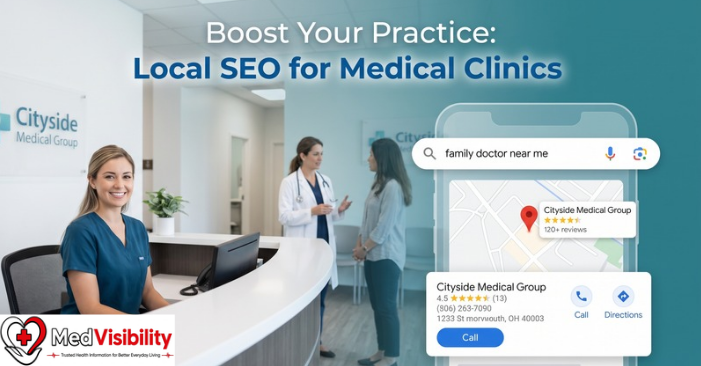
Local SEO is the process of optimising your clinic’s online presence so it appears in searches tied to a location think “GP near me,” “dentist in Manchester,” or “physiotherapist open today.” It combines your Google Business Profile, your website, online reviews, and local citations (mentions of your clinic’s name, address, and phone number across the web) into a signal search engines use to decide who to show first.
For medical clinics specifically, local SEO carries extra weight because:
- Most patients search with immediate, location-based intent rather than researching brands over weeks.
- Trust signals reviews, credentials, accurate information influence decisions more than in most other industries.
- A large share of searches happen on mobile, often followed by a phone call or a “get directions” tap within minutes.
- Google’s local results (the “map pack”) often appear above standard website listings, so visibility there can matter more than traditional rankings.
In short, if your clinic isn’t visible locally, it’s effectively invisible to a large share of the patients actively looking for care.
How Local SEO Differs From General SEO
General SEO focuses on ranking a website for broad, often global search terms. Local SEO narrows that focus to a specific geographic area and layers in location-based ranking factors that don’t apply elsewhere. A few key differences:
| Factor | General SEO | Local SEO for Clinics |
|---|---|---|
| Main goal | Rank nationally/globally for a topic | Rank for a service within a specific area |
| Key platform | Website content and backlinks | Google Business Profile + website + reviews |
| Search intent | Often research-based | Often urgent, decision-ready |
| Trust signals | Domain authority, content depth | Reviews, NAP consistency, credentials |
| Typical outcome | Website traffic | Phone calls, direction requests, bookings |
Understanding this distinction matters because clinics that only invest in a well-designed website — without addressing local ranking factors — often see disappointing results, even with strong content.
The Core Building Blocks of Local SEO for Medical Clinics
1. Google Business Profile (GBP)
Your Google Business Profile is arguably the single most important local SEO asset a clinic has. It’s the listing that appears in Google Maps and the local map pack, showing your hours, address, phone number, reviews, and photos before a searcher even clicks through to your site.
A well-optimised profile typically includes:
- Accurate, consistent business name, address, and phone number (often referred to as “NAP”)
- Correct primary and secondary categories (e.g., “Medical Clinic,” “General Practitioner,” “Physiotherapist”)
- Complete service descriptions
- Regularly updated photos of the clinic, team, and facilities
- Accurate opening hours, including holiday adjustments
- Prompt responses to patient questions and reviews
Clinics that keep this profile active — posting updates, answering questions, adding new photos — tend to be viewed more favourably than those that set it up once and forget it.
2. NAP Consistency Across the Web
NAP consistency means your clinic’s name, address, and phone number match exactly everywhere they appear online — your website, Google, health directories, insurance panels, and local business listings. Even small inconsistencies (a missing suite number, an old phone number, “St.” versus “Street”) can confuse search engines about which listing is authoritative, which in turn can quietly hurt rankings.
A periodic audit across major directories — Google, Bing Places, Apple Maps, NHS service pages where applicable, and relevant health directories — helps catch these mismatches before they affect visibility.
3. Online Reviews and Reputation
Reviews influence both rankings and patient decisions. A clinic with dozens of recent, detailed, positive reviews is more likely to be trusted — by both patients and Google — than one with a handful of outdated ones.
Practical, ethical ways to build a healthy review profile include:
- Asking satisfied patients directly, in person or via a follow-up message, whether they’d be willing to leave a review
- Making the process easy with a direct review link
- Responding to every review, positive or negative, professionally and without disclosing any patient health information
- Never offering incentives in exchange for reviews, which violates most platforms’ guidelines and can damage trust if discovered
Consistency matters more than volume. A steady flow of a few reviews a month tends to perform better long-term than a single rushed batch.
4. Local Website Content
Your website should clearly communicate what the clinic treats, where it’s located, and who it serves. This includes:
- Location-specific pages if you operate multiple sites (e.g., “Physiotherapy in Leeds” rather than one generic page)
- Clear service pages that explain conditions treated, in plain language patients will actually search for
- An accessible, mobile-friendly design, since most local searches happen on phones
- Fast loading times, as slow sites tend to lose visitors — and rankings — quickly
Content should be written for patients first, not search engines. Clear, accurate, jargon-free explanations tend to perform better in modern search results, including AI-generated overviews, than content stuffed with keywords.
5. Local Citations and Directory Listings
Citations are mentions of your clinic across health directories, local business listings, and industry-specific platforms. Beyond general listings like Google and Bing, clinics benefit from being listed accurately on relevant healthcare directories and, where applicable, insurance provider directories. Each accurate listing reinforces your clinic’s legitimacy and location to search engines. local seo for medical clinics.
6. Structured Data (Schema Markup)
Adding structured data — code that helps search engines understand what your website content means — can help your clinic’s information display more clearly in search results, including opening hours, ratings, and medical specialities. This is a technical step best handled by a developer or SEO specialist, but it’s worth requesting specifically, as many general web designers skip it. local seo for medical clinics.
Local SEO and Google’s Recent Search Updates
Search engines have shifted noticeably toward rewarding genuinely useful, well-organised, patient-first content, and away from pages built primarily to manipulate rankings. For medical clinics, this means:
- Clear, accurate, and honest information tends to outperform vague or exaggerated marketing language.
- Pages that answer real patient questions directly — in plain English — are increasingly favoured, including in AI-generated search summaries. local seo for medical clinics.
- Consistency, transparency, and demonstrable expertise (correct clinician credentials, accurate service details) carry more weight than they once did.
- Thin, generic, or duplicated content across multiple location pages is more likely to be filtered out or ranked poorly. local seo for medical clinics.
The practical takeaway is that clinics investing in accurate, well-structured, genuinely helpful content and listings tend to be more resilient to search algorithm changes than those relying on shortcuts.
Common Local SEO Mistakes Clinics Make
- Inconsistent business information across the website, Google, and directories
- Ignoring reviews, especially negative ones, instead of responding professionally
- Duplicate or thin content across multiple location or service pages
- Outdated Google Business Profile details, such as old hours or closed services
- No mobile optimisation, despite most local searches happening on phones
- Overlooking accessibility, which affects both patient experience and search visibility
Most of these are fixable without a large budget — they simply require regular attention rather than a one-time setup.
Realistic Expectations: What Local SEO Can and Can’t Do
Local SEO can meaningfully increase how easily nearby patients find and choose your clinic. It’s not, however, an instant fix. Rankings typically improve gradually over weeks and months as search engines build trust in a consistent, accurate, well-reviewed listing. Clinics in highly competitive areas, such as city centres with many similar practices, may need sustained effort to stand out. local seo for medical clinics.
It’s also worth noting that local SEO works best alongside — not instead of — genuine quality of care and patient experience. A strong online presence can bring patients through the door, but reviews and word of mouth will ultimately reflect the actual experience they have once they arrive.
When to Bring in Professional Help
Clinics with limited time or in-house expertise often benefit from working with an SEO specialist experienced in healthcare marketing, particularly for technical elements like structured data, website speed, and multi-location strategy. When choosing outside help, it’s reasonable to ask for examples of past healthcare clients, a clear explanation of their methods, and reassurance that all practices comply with advertising and patient privacy standards relevant to your region.
READ MORE: How Long Can Humans Live Maximum Lifespan? 5 Truths
Key Takeaways
- Local SEO helps nearby patients find your clinic when they search for relevant care.
- A complete, actively managed Google Business Profile is one of the highest-impact steps a clinic can take.
- Consistent business information (NAP) across the web supports trust and rankings.
- Genuine, regularly earned reviews matter more than volume alone. local seo for medical clinics.
- Patient-first, plain-English website content performs better under current search standards.
- Results build gradually — local SEO is a sustained effort, not a one-time fix.
Summary
Local SEO for medical clinics is the practice of optimising a clinic’s Google Business Profile, website, and online listings so it appears prominently when nearby patients search for relevant care, helping increase visibility, calls, and bookings from local search results. local seo for medical clinics.
FAQs
How long does local SEO take to show results for a clinic?
Most clinics start noticing gradual improvements within two to four months, with more significant results typically building over six months to a year. Timelines vary depending on competition in the area and how consistently the work is maintained.
Is a Google Business Profile really necessary if we already have a website?
For local searches, Google’s map pack often appears above standard website listings, meaning an incomplete or inactive Google Business Profile can cost a clinic visibility even if the website itself is excellent.
Can negative reviews be removed?
Only in specific cases, such as reviews that violate a platform’s policies (fake reviews, hate speech, clearly unrelated content). Genuine negative reviews generally can’t be removed and are better addressed with a calm, professional public response.
Do multi-location clinics need a separate page for each location?
Generally, yes. Search engines tend to favour distinct, genuinely useful content for each location rather than one generic page listing multiple addresses.
Is local SEO different for specialist clinics versus general practices?
The core principles are similar, but specialist clinics often benefit from more detailed condition-specific content, since patients searching for a specialist tend to search with more precise terms.
Does local SEO help with patient trust, not just visibility?
Accurate information, genuine reviews, and a well-maintained online presence all contribute to a patient’s sense of trust before they’ve even walked through the door.
For more updates visit: medvisibility.co.uk

Other Articles
How to Rank Your Clinic on Google Maps in 2026
Early Signs of Hypertension UK What to Watch For





[…] reviews carry enormous weight, but responding to them requires care: confidentiality rules mean you generally cannot confirm a named individual […]
[…] READ MORE: Local SEO for Medical Clinics A Practical Guide […]
[…] SEO is the practice of optimising health-related websites and content articles, clinic pages, condition guides, treatment explainers […]
[…] daily life, that’s a sign to speak with a GP or a mental health professional rather than trying to manage it alone. healthy lifestyle tips […]
[…] sense of how many new patients it generates, or if competitors consistently outrank it for obvious searches, that’s usually a sign the current approach isn’t being actively managed rather than a […]
[…] presence so your practice appears when people nearby search for the services you offer think “dentist in Leeds,” “private GP near me,” or “physiotherapy for lower back pain […]