



You’ve probably typed “how to lose weight fast UK” into Google at least once, usually late at night, usually after a day where the scales didn’t move the way you hoped. You’re not alone. It’s one of the most-searched health questions in Britain, and honestly, that makes sense most of us don’t want a five-year plan, we want results we can actually see.
Here’s the honest truth before we go any further: genuine “fast” weight loss and safe weight loss aren’t opposites, but they do have a speed limit. The NHS and most UK dietitians agree that losing weight at a rate of 0.5kg to 1kg (roughly 1–2lbs) a week is the fastest pace your body can sustain without burning through muscle, tanking your energy, or setting you up to regain it all a few months later. That might sound slower than the headlines promise, but it’s also the version of “fast” that actually sticks.
This guide walks through what really drives weight loss, how to set a realistic UK-based plan, which shortcuts are worth trying and which ones to skip, and when it’s worth speaking to your GP.
This article is for general information only and isn’t a substitute for personalised medical advice. If you have a health condition, take medication, or are pregnant or breastfeeding, speak to your GP or a registered dietitian before changing your diet or activity levels significantly.
What Actually Makes You Lose Weight
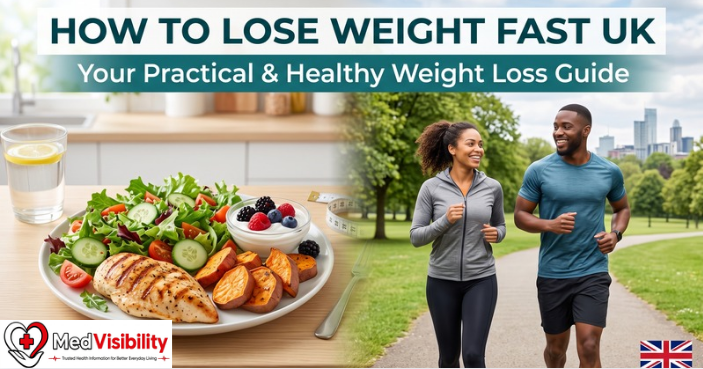
Strip away the fads and it comes down to one principle: a calorie deficit consistently taking in fewer calories than your body uses. Everything else (protein timing, meal windows, “detoxes”) either supports that deficit or is largely noise. how to lose weight fast UK.
According to NHS guidance, most adult men need around 1,900–2,500 kcal a day to maintain their current weight, and most women need around 1,400–2,000 kcal, though this varies a lot depending on height, age, muscle mass, and activity level. A deficit of around 500 kcal a day tends to produce roughly 0.5kg of fat loss a week; a larger deficit of around 1,000 kcal a day can produce closer to 1kg which is why the NHS uses that 0.5–1kg range as its safe upper limit, not a minimum to beat.
Going much further below that think very-low-calorie crash diets can trigger muscle loss, nutrient deficiencies, gallstones, hormonal disruption, and a slower metabolism over time, according to NHS and Mayo Clinic guidance. It also tends to backfire: the more extreme the restriction, the more likely people are to regain the weight (and sometimes more) within a year.
Setting a Realistic UK Weight Loss Plan
1. Start With Your Why (and Your Baseline)
Before touching your diet, get a sense of where you’re starting. The NHS BMI healthy weight calculator (free on nhs.uk) is a reasonable starting point, though it’s worth remembering BMI doesn’t account for muscle mass or where fat is carried — waist circumference is a useful second measure alongside it.
2. Aim for the First 5%, Not the Final Stone
Clinically, losing just 5% of your body weight is the first meaningful milestone — it’s linked to measurable improvements in blood pressure, blood sugar, and cholesterol, often before you’ve reached a “goal weight” at all. Targeting that first, smaller number tends to feel far more achievable than staring down a big total.
3. Build Your Plate, Don’t Just Cut It
Rather than obsessing over calorie counting from day one (though tracking with an app like NHS’s own Weight Loss Plan, MyFitnessPal, or Nutracheck can help many people), focus on rebuilding your plate:
- Fill half your plate with vegetables and fruit — high in fibre and volume, low in calories.
- Choose wholegrain carbs (brown rice, wholemeal bread, oats) over refined ones — they keep you fuller for longer. how to lose weight fast UK.
- Prioritise protein at each meal — lean meat, fish, eggs, beans, lentils, tofu. Protein supports muscle retention during weight loss and is more satiating than fat or refined carbs.
- Cut back on liquid calories — sugary drinks, fruit juice, and alcohol are among the easiest wins for a lot of people, since they add calories without much fullness in return.
- Watch portion sizes, especially with takeaways and processed food, which tend to be far more energy-dense than home-cooked meals. how to lose weight fast UK.
4. Move More, Beyond the Gym
The NHS recommends at least 150 minutes of moderate-intensity activity a week — brisk walking, cycling, swimming, or a mix. You don’t need a gym membership to hit that. A daily 20–25 minute walk, taking the stairs, or cycling to work all count. Strength training two or more days a week is also worth adding where possible — it helps preserve muscle mass while you’re in a calorie deficit, which keeps your metabolism working in your favour. how to lose weight fast UK.
5. Sleep and Stress Aren’t Side Notes
Poor sleep and chronic stress both raise cortisol and ghrelin (the “hunger hormone”), which can make cravings — particularly for high-calorie, high-sugar foods — harder to manage. Aiming for 7–9 hours of sleep and building in some form of stress management (even a short daily walk or breathing exercise) genuinely supports weight loss efforts, not just general wellbeing. how to lose weight fast UK.
READ MORE: BWSI Medlytics How Medical Data Science Is Transforming Healthcare
Realistic Weight Loss Timeline
| Starting Point | Weekly Loss (NHS-Safe Range) | Approx. Time to Lose 5% Body Weight* |
|---|---|---|
| 70kg | 0.35–0.7kg | 5–10 weeks |
| 85kg | 0.4–0.85kg | 5–11 weeks |
| 100kg | 0.5–1kg | 5–10 weeks |
Figures are illustrative averages, not guarantees — individual results vary with metabolism, activity, hormones, and adherence. how to lose weight fast UK.
Shortcuts People Ask About — What’s Worth It and What Isn’t
Intermittent Fasting
Approaches like 16:8 or the 5:2 diet can work for some people simply because they naturally reduce the eating window and total calories consumed. There’s nothing magic about the fasting itself — it’s a tool some people find easier to stick to than constant calorie counting. It isn’t suitable for everyone, including people with a history of disordered eating, diabetes, or who are pregnant.
Low-Carb and Keto Diets
These can produce fast initial results, partly from water loss as glycogen stores deplete, and partly from genuine fat loss if a calorie deficit is maintained. Longer term, most research suggests low-carb diets aren’t meaningfully more effective than other approaches once calories are matched — the best diet is usually the one you can actually maintain. how to lose weight fast UK.
Weight Loss Injections (e.g. Semaglutide, Tirzepatide)
These prescription-only medications have gained significant attention in the UK and can produce substantial weight loss for some people, but they are prescription medicines with real side effects and are intended to be used alongside — not instead of — diet and lifestyle changes, and under medical supervision. They are not “fast fixes” available over the counter, and buying them without a prescription carries real safety risks. If you’re curious whether you’re a candidate, that conversation belongs with your GP or a registered prescriber.
Detox Teas, Fat-Burning Supplements, and “Miracle” Products
Worth flagging clearly: there is no supplement, tea, or pill with strong, consistent evidence of significant fat loss on its own. Some are simply diuretics or mild laxatives, which cause temporary water-weight changes, not fat loss, and can be genuinely harmful with regular use. If a product promises rapid, effortless fat loss, that’s a strong signal to be sceptical. how to lose weight fast UK.
Common Mistakes That Slow Progress
- Being too restrictive too soon — leads to burnout and rebound eating.
- Skipping meals — often leads to overeating later and can affect energy and concentration.
- Ignoring protein — increases the risk of losing muscle alongside fat.
- Weighing in daily and reacting to normal fluctuations — weight naturally shifts by 1–2kg day to day due to water, hormones, and food volume. Weekly weigh-ins, same time, same conditions, give a truer picture.
- Restarting from zero after a bad day — one off-plan meal doesn’t undo a week of progress; the plan that works is the one you return to quickly.
When to See a Doctor
It’s worth speaking to your GP before starting a new weight loss plan, or sooner, if:
- You have a BMI of 30 or above — you may be eligible for free NHS weight management support, including the NHS Digital Weight Management Programme.
- You have an existing health condition such as diabetes, heart disease, or thyroid issues.
- You’re pregnant, breastfeeding, or trying to conceive.
- You notice sudden or unexplained weight loss you weren’t trying for.
- You find yourself thinking about food, weight, or exercise in ways that feel obsessive, distressing, or out of your control. how to lose weight fast UK.
None of the above are signs to push through alone — a GP referral can open up free, structured, medically supervised support.
READ MORE: High Blood Pressure Symptoms UK What to Watch For
Key Takeaways
- Safe, sustainable weight loss in the UK is 0.5–1kg a week, based on NHS guidance — that pace is the genuine “fast” ceiling for lasting results.
- A calorie deficit is the core driver of fat loss; everything else supports it.
- Aim for the first 5% of body weight as an early, meaningful milestone.
- Protein, fibre, and strength training help protect muscle while you lose fat.
- Be sceptical of supplements or products promising rapid, effortless results.
- Speak to your GP if your BMI is 30+, you have a health condition, or your relationship with food or exercise starts to feel unhealthy.
FAQs
Can you really lose weight fast in the UK without it being unsafe?
“Fast but safe” tops out at around 1kg a week for most adults, per NHS guidance. Anything faster usually comes from water loss, muscle loss, or unsustainable restriction rather than genuine fat loss.
How many calories should I cut to lose weight?
A deficit of around 500 kcal a day is a commonly used starting point for roughly 0.5kg of weekly loss, though individual calorie needs vary by height, weight, age, sex, and activity level — a GP or dietitian can help personalise this.
Is intermittent fasting effective for UK weight loss goals?
It can work for some people because it naturally reduces overall calorie intake, but it isn’t inherently more effective than other calorie-controlled approaches, and it isn’t suitable for everyone.
Are weight loss injections like Wegovy available fast in the UK?
They’re prescription-only medicines available through a GP or registered prescriber based on clinical criteria, not an instant or over-the-counter option, and they work best alongside diet and lifestyle changes.
Why has my weight loss stalled?
Plateaus are a normal part of the process as your body adapts to a lower weight and calorie intake. Reviewing portion sizes, activity levels, and sleep, rather than cutting calories further, is usually the better first step.
Does exercise alone help you lose weight fast?
Exercise supports weight loss and is essential for overall health, but diet typically has a bigger impact on the number on the scales — combining both gives the best, most sustainable results.
For more updates visit: medvisibility.co.uk

Other Articles



[…] of this means weight loss is harder or impossible for women — it means the approach needs to work with your biology, not […]
[…] individuals with disabilities, and those with chronic health conditions live independently and safely at […]