



Throughout human history, the dream of living a longer, healthier life has fascinated philosophers, scientists, and everyday people alike. From ancient myths of magical fountains to modern longevity clinics spending millions on cellular rejuvenation, our curiosity about aging never seems to fade.
In recent decades, average life expectancy around the world has increased dramatically thanks to improved sanitation, vaccines, antibiotics, and better cardiovascular care. A child born today in the UK or another developed nation can reasonably expect to reach their late 70s or 80s. However, living longer as a population raises a fundamental question that aging researchers have debated for centuries: is there a hard ceiling on human longevity?
When researchers examine extreme survival records, one central question always comes up: how long can humans live maximum lifespan under optimal biological conditions? To answer this, we need to look beyond average birth statistics and dive into cellular biology, genetics, physiological resilience, and the distinction between merely surviving and staying truly healthy.
Lifespan, Life Expectancy, and Healthspan: Clearing up the Confusion
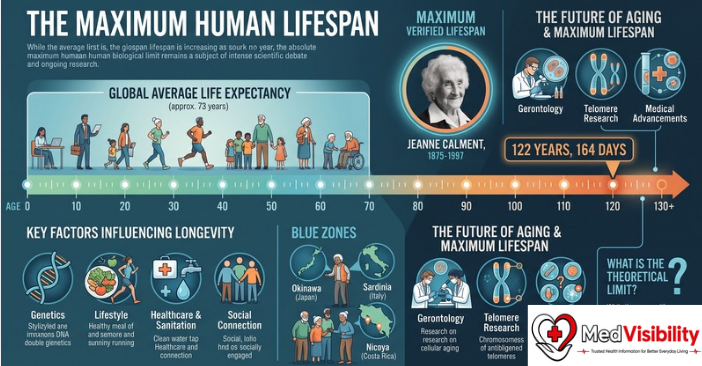
Before diving into the biology of aging, it helps to clarify three terms that are often used interchangeably in news articles, but mean very different things in medical science. how long can humans live maximum lifespan.
┌────────────────────────────────────────────────────────────────────────┐
│                        THREE DIMENSIONS OF AGING                       │
├───────────────────┬──────────────────────────────┬─────────────────────┤
│      METRIC       │          DEFINITION          │     GLOBAL STATUS   │
├───────────────────┼──────────────────────────────┼─────────────────────┤
│ Life Expectancy   │ Statistical average age a    │ ~72–82 years        │
│                   │ person survives from birth   │ (Varies by country) │
├───────────────────┼──────────────────────────────┼─────────────────────┤
│ Maximum Lifespan  │ Upper biological limit an    │ 122 years           │
│                   │ individual can reach         │ (Jeanne Calment)    │
├───────────────────┼──────────────────────────────┼─────────────────────┤
│ Healthspan        │ Years lived free from chronic│ ~63–70 years        │
│                   │ disease and frailty          │ (Aims to widen)     │
└───────────────────┴──────────────────────────────┴─────────────────────┘
1. Life Expectancy
Life expectancy is a statistical calculation reflecting the average number of years a newborn infant is expected to live, based on current mortality rates in a given country or population. Global life expectancy in the early 1900s was under 35 years, largely due to high infant mortality and infectious diseases. Today, the worldwide average sits at roughly 72 to 73 years. In the UK, according to Office for National Statistics (ONS) data, life expectancy is approximately 79 years for men and 83 years for women.
2. Maximum Lifespan
Maximum lifespan refers to the absolute maximum age an individual member of a species has been proven to achieve. Unlike life expectancy, which fluctuates based on healthcare, poverty, and public health policies, maximum lifespan is dictated by fundamental biological constraints, cellular division limits, and genetics.
3. Healthspan
Healthspan is arguably the most vital concept for individual wellness. It measures the period of your life spent in good health, free from disabling chronic illnesses, severe cognitive decline, or loss of independence. Modern medicine excels at extending lifespan through chronic disease management, but extending healthspan—so that your final decades are vibrant and active—remains the primary goal of preventive healthcare.
The Record Holders: Who Has Lived the Longest?
To understand human limits, demographers turn to verified birth records. The official, undisputed record for the longest human life belongs to Jeanne Calment, a French woman born in Arles in 1875. When she passed away in 1997, she had reached the verified age of 122 years and 164 days. She outlived both her daughter and grandson and famously rode a bicycle past her 100th birthday. how long can humans live maximum lifespan.
The longest-lived man on record is Jiroemon Kimura from Japan, who died in 2013 at 116 years and 54 days.
VERIFIED LONGEVITY MILESTONES

• Longest Verified Human Life: Jeanne Calment (France) — 122 years, 164 days
• Longest Verified Male Life: Jiroemon Kimura (Japan) — 116 years, 54 days
• Supercentenarian Threshold: Reaching age 110 or older
• Semi-Supercentenarian Threshold: Reaching age 105 or older
What makes Jeanne Calment’s record remarkable is that nearly three decades after her death, no verified person has officially surpassed her. Millions of people have turned 100 or 110 since 1997, yet no one has pushed past the 122-year mark. This plateau has led many biogerontologists to suspect that Calment may have been a biological outlier sitting right at the absolute ceiling of natural human capability.
When analyzing supercentenarians (people who reach 110 or older), scientists consistently find that these individuals do not necessarily avoid all health risks during their lives, but their bodies show an unusual ability to delay age-related chronic diseases like cancer, heart disease, and Alzheimer’s until their final years—a phenomenon known as the “compression of morbidity”. how long can humans live maximum lifespan.
What Does Science Say? The Biological Limits to Human Longevity
When investigating how long can humans live maximum lifespan, biological markers provide essential clues regarding why our organs eventually wear out. Modern biogerontology looks at aging not as a single disease, but as a complex accumulation of damage across multiple biological systems.
                     BIOLOGICAL FACTORS LIMITING LIFESPAN
                                      │
    ┌─────────────────────────────────┼─────────────────────────────────┐
    ▼                                 ▼                                 ▼
Hayflick Limit &            Physiological Resilience           Somatic DNA Damage
Telomere Attrition           Dynamic Loss (~120–150 yrs)        Accumulation Over Time
1. The Hayflick Limit and Telomeres
In 1961, biologist Leonard Hayflick discovered that normal human somatic cells (like skin or liver cells) can only divide a finite number of times—typically between 40 and 60 times—before stopping permanently. This phenomenon is known as the Hayflick Limit.
At the end of every chromosome sit protective caps called telomeres, which act like the plastic tips on shoelaces. Each time a cell divides, its telomeres shorten slightly. When telomeres become critically short, the cell enters a state called cellular senescence—it stops dividing, secretes inflammatory compounds, and eventually contributes to tissue breakdown. While an enzyme called telomerase can rebuild telomeres, it is active mainly in stem cells and germ cells; in normal body tissues, telomere loss acts as a ticking biological clock. how long can humans live maximum lifespan.
2. Loss of Physiological Resilience
A groundbreaking study published in Nature Communications examined dynamic blood markers and physical step counts across thousands of individuals to evaluate how quickly the human body recovers from daily stress, illness, or physical exertion. how long can humans live maximum lifespan.
The researchers discovered that human resilience—our capacity to bounce back after physical disruption—declines linearly as we age:
- In young adults, recovery from minor illness or sleep deprivation takes a few days.
- In an 80-year-old, full recovery can take weeks. how long can humans live maximum lifespan.
- By age 120 to 150, mathematical models show that physiological resilience approaches zero.
Without this recovery capacity, even trivial stresses—like a slight drop in temperature, minor dehydration, or a mild infection—become fatal because the organ systems lose the dynamic buffer necessary to restore internal balance (homeostasis).
3. Somatic DNA Mutations
Another key mechanism in lifespan limitation is the accumulation of somatic mutations—spontaneous DNA errors that occur every time cells replicate or encounter environmental hazards like sunlight, toxins, and metabolic waste.
Recent mathematical modeling studies published in journals like npj Aging evaluated what would happen if every reversible marker of aging (such as nutrient signaling or stem cell exhaustion) was treated or reversed, leaving only somatic mutations. The models estimated that irreplaceable cells—such as brain neurons and cardiac muscle cells, which divide very little during adulthood—accumulate irreversible genetic damage over time. This creates a natural ceiling for human survival in the range of 146 to 194 years, even under theoretically perfect conditions. how long can humans live maximum lifespan.
       CELLULAR AGING TIMELINE: FROM HEALTHY TO SENESCENCE

 [Young Healthy Cell]  ──>  [Dividing Cell]  ──>  [Telomeres Shorten]
                                                        │
                                                        ▼
 [Organ Dysfunction]   <──  [Tissue Damage]  <──  [Senescent Cell]
Genetics vs. Lifestyle: What Really Determines Your Lifespan?
If maximum potential human lifespan is roughly 120 to 150 years, why do most people die decades earlier? The gap between average life expectancy and maximum lifespan is influenced by a combination of genetics, environmental factors, and daily habits. how long can humans live maximum lifespan.
┌────────────────────────────────────────────────────────────────────────┐
│                   GENETICS VS. LIFESTYLE CONTRIBUTION                  │
├─────────────────────────┬──────────────────────────────────────────────┤
│  Under Age 80           │ ~20–25% Genetics  |  ~75–80% Lifestyle        │
├─────────────────────────┼──────────────────────────────────────────────┤
│  Past Age 100           │ ~60–80% Genetics  |  ~20–40% Lifestyle        │
└─────────────────────────┴──────────────────────────────────────────────┘
Understanding how long can humans live maximum lifespan requires separating genetic predisposition from daily lifestyle habits. Studies on twins demonstrate that for the general population living under age 80, genetics accounts for only 20% to 25% of lifespan variation. The remaining 75% to 80% comes down to lifestyle factors: diet, physical activity, sleep hygiene, social connection, and environmental exposures (such as pollution and smoking). how long can humans live maximum lifespan.
However, for supercentenarians who live past 100, the influence flips. Reaching 105 or 110 almost always requires a genetic “winning ticket”—rare gene variants related to lipid metabolism, DNA repair, and low inflammatory responses that protect the body against heart disease and cancer even in the presence of poor habits. how long can humans live maximum lifespan.
Lessons from the Blue Zones
Demographers have identified several regions worldwide—known as “Blue Zones”—where populations reach age 100 at rates up to ten times higher than average:
- Okinawa, Japan: High intake of vegetables, tofu, and sweet potatoes; strong social circles (moai); practice of hara hachi bu (eating until 80% full).
- Sardinia, Italy: Plant-rich Mediterranean diet, steep hill walking as part of daily routines, strong family bonds. how long can humans live maximum lifespan.
- Nicoya, Costa Rica: Nutrient-rich calcium and magnesium water, daily sunlight exposure, deep sense of life purpose (plan de vida).
- Ikaria, Greece: Herbal teas, olive oil, frequent naps, active community lifestyle.
- Loma Linda, California: Vegetarian diet, regular exercise, sabbath rest, focus on faith and family.
None of these populations rely on expensive anti-aging medications or extreme biohacks. Instead, their longevity comes from daily, low-intensity movement, real food, strong relationships, low chronic stress, and restful sleep.
Practical Steps to Maximize Your Personal Healthspan
While ongoing medical research attempts to push the boundary of how long can humans live maximum lifespan, everyday habits dictate your personal quality of life. You may not have supercentenarian genes, but you can adopt evidence-based practices that prevent premature cellular aging and keep your organs functioning optimally for as long as possible.
                       THE LONGEVITY FOUNDATION
                                  │
      ┌─────────────────┬─────────┴─────────┬─────────────────┐
      ▼                 ▼                   ▼                 ▼
 Cardiovascular      Muscle & Strength     Whole-Food        Restorative
 Exercise & VO2 Max    Retention           Nutrition         Sleep & Calm
1. Optimize Cardiovascular Fitness (VO2 Max)
Cardiorespiratory fitness is one of the strongest predictors of all-cause mortality. High cardiorespiratory fitness (measured by VO2 max, or the maximum amount of oxygen your body can utilize during exercise) is strongly associated with a lower risk of early death from heart disease, stroke, and diabetes.
- Actionable Tip: Aim for 150 to 300 minutes of moderate-intensity aerobic activity per week (brisk walking, cycling, swimming), combined with 1 to 2 sessions of high-intensity interval training (HIIT) if medically appropriate.
2. Preserve Muscle Mass and Bone Density
Sarcopenia—the gradual loss of skeletal muscle mass and strength—starts around age 30 and accelerates after age 60. Muscle loss leads to frailty, metabolic dysfunction, higher fall risks, and slower illness recovery.
- Actionable Tip: Perform resistance training (weightlifting, bodyweight squats, resistance bands) at least twice a week. Ensure adequate daily dietary protein intake to support muscle repair and maintenance.
3. Adopt an Anti-Inflammatory Diet Pattern
Chronic, low-grade systemic inflammation (often called “inflammaging”) damages blood vessels, joint tissue, and brain cells over time. Diets rich in ultra-processed foods, refined sugars, and industrial seed oils accelerate cellular damage.
- Actionable Tip: Base your diet on whole, minimally processed foods: colorful vegetables, berries, legumes, nuts, seeds, whole grains, extra virgin olive oil, and oily fish (like salmon, sardines, and mackerel) rich in omega-3 fatty acids.
4. Prioritize Deep, Restorative Sleep
During deep sleep, the brain’s glymphatic system clears out metabolic waste products, including beta-amyloid proteins linked to cognitive decline. Poor sleep disrupts glucose regulation, increases cortisol, and accelerates vascular aging.
- Actionable Tip: Maintain a consistent sleep-wake schedule 7 days a week. Keep your bedroom dark, quiet, and cool (around 16–18°C), and turn off screens 60 to 90 minutes before bedtime.
5. Nurture Social Connections and Emotional Well-being
Longitudinal studies, such as the famous Harvard Study of Adult Development, show that warm, trusting personal relationships are a greater predictor of long-term health and happiness than blood cholesterol levels or income. Chronic loneliness creates stress responses equivalent to smoking 15 cigarettes a day.
- Actionable Tip: Invest time in family, friendships, volunteering, or community groups. Finding meaning and daily purpose keeps stress hormones balanced and supports brain health.
Comparison Table: Modern Longevity Strategies
To help you distinguish proven everyday health habits from emerging anti-aging therapies, here is how popular strategies compare based on current scientific evidence:
| Longevity Strategy | Target Mechanism | Primary Benefits | Scientific Evidence Level | Safety & Accessibility |
| Aerobic & Strength Training | Improves mitochondrial function, insulin sensitivity, cardiovascular output, muscle preservation. | Lower risk of heart disease, diabetes, cancer, dementia, and physical frailty. | Extremely High (Decades of clinical trials) | Safe for almost everyone; free or low-cost. |
| Mediterranean-Style Diet | Reduces systemic inflammation, oxidative stress, and gut dysbiosis. | Protects arterial health, lowers stroke risk, supports gut microbiome. | Extremely High (Population and clinical trial data) | Highly accessible, daily sustainable diet pattern. |
| Quality Sleep (7–9 hrs) | Glymphatic brain clearance, cellular repair, hormone balance, immune regulation. | Prevents metabolic dysfunction, supports cognitive performance and immune health. | Extremely High (Extensive physiological research) | Safe; requires sleep hygiene discipline. |
| Caloric Restriction / Fasting | Triggers autophagy (cellular cleanup), suppresses mTOR signaling pathway. | Potential reduction in cellular metabolic stress and improved insulin control. | Moderate to High (Strong animal data; emerging human trials) | Needs careful planning to avoid nutrient deficiency or muscle loss. |
| Geroscience Therapeutics (e.g., Rapamycin, Senolytics) | Targeted removal of senescent cells, alteration of metabolic aging pathways. | Aimed at delaying multiple age-related chronic conditions simultaneously. | Experimental (Human clinical trials ongoing) | Medical supervision required; long-term human safety unknown. |
When to See a Doctor: Preventive Health Screening
Living a long, healthy life depends heavily on catching potential health issues before they turn into serious conditions. Many major age-related conditions—including hypertension, high cholesterol, type 2 diabetes, early-stage chronic kidney disease, and fatty liver—develop quietly without early symptoms.
READ MORE: Intermittent Fasting for Beginners UK A Simple, Honest Starting Guide
       ESSENTIAL PREVENTIVE HEALTH CHECKS

  • Blood Pressure Screening (At least annually)
  • Lipid Panel & HbA1c (Cholesterol & blood glucose)
  • NHS Health Check (For UK adults aged 40–74)
  • Age-Appropriate Cancer Screenings (Bowel, breast, cervical)
  • Bone Density & Sarcopenia Assessments (Age 60+)
You should consult your GP or healthcare provider if you experience any of the following warning signs:
- Unexplained Weight Loss or Fatigue: Unintentional weight drop or persistent exhaustion that rest does not relieve.
- Changes in Mobility or Balance: Difficulty getting up from a chair, frequent stumbling, or loss of leg strength.
- Cognitive Changes: Unusual memory lapses, difficulty managing routine tasks, or confusion with dates and times.
- Shortness of Breath or Chest Tightness: Any discomfort during light physical exertion that you previously handled comfortably.
- Persistent Joint or Muscle Pain: Pain that limits your daily movement or prevents routine exercise.
Routine preventive health checks—such as the NHS Health Check offered in the UK for adults aged 40 to 74—help identify risk factors early so you can make effective lifestyle modifications.
Summary
When we ask how long can humans live maximum lifespan, the science points toward a natural, biological limit somewhere between 120 and 150 years. While future scientific advances in stem cell therapy, gene editing, and cellular clearance may eventually alter these constraints, our primary focus today should be bridging the gap between average life expectancy and healthy lifespan.
Living a long life is not about finding a magic pill or adopting extreme daily regimes. It comes down to basic, consistent lifestyle habits: keeping your body moving, eating real food, prioritizing restorative sleep, cultivating meaningful relationships, and managing chronic stress. By taking care of your cellular health today, you give yourself the best possible chance of enjoying an active, independent, and vibrant life well into your later years.
FAQs
Will science ever allow humans to live to 200 years old?
Currently, there is no verified scientific method or medical therapy that allows a human being to reach 200 years of age. While theoretical computer models exploring cellular repair suggest extreme ceilings, real-world human biology is bound by cellular division caps (Hayflick limit), somatic mutation accumulation, and the eventual loss of organ system resilience. Modern longevity science focuses primarily on extending healthspan—keeping people disease-free until the end of life—rather than pushing maximum biological limits to extreme ages.
Is aging considered a disease that can be cured?
In classical medicine, aging is classified as a natural biological process rather than a disease. However, biogerontologists view aging as the root driver of major diseases like cancer, cardiovascular disease, and neurodegeneration. Research fields like geroscience aim to target the underlying biological hallmarks of aging—such as senescent cells, inflammation, and DNA damage—to delay multiple chronic diseases at once.
What is the difference between lifespan and healthspan?
Lifespan is the total number of years an individual lives from birth to death. Healthspan is the number of those years spent in good health, free from disabling chronic conditions, pain, or severe cognitive impairment. Increasing healthspan ensures that growing older comes with continued vitality, independence, and good quality of life.
Do anti-aging supplements like NMN or Resveratrol work?
While molecules like NMN (nicotinamide mononucleotide) and resveratrol have shown promising results in animal trials (such as mice) by raising NAD+ levels or activating sirtuins, human clinical trials have produced mixed results. No single supplement has been clinically proven to extend maximum human lifespan. Established lifestyle practices—such as exercise, balanced nutrition, and good sleep—remain far more effective than over-the-counter supplements.
Why do women generally live longer than men?
Statistically, women outlive men in almost every country worldwide. Biological factors include the protective vascular effects of estrogen before menopause, lower rates of visceral abdominal fat, and having two X chromosomes (which provides a backup copy for mutated genes). Behavioral factors also play a role: men historically have had higher rates of smoking, risk-taking behaviors, occupational hazards, and lower rates of routine health checkups.
For more updates visit: medvisibility.co.uk

Other Articles
How to Start Working Out After 40 (Without Burning Out)





No Comment! Be the first one.