



Search for “GP near me” or “physiotherapist [your town]” and notice what actually shows up first. It’s rarely a homepage. It’s a small block of three listings with a map, star ratings, and an “Open now” tag Google’s Local Pack. If your practice isn’t in it, a meaningful share of nearby patients never scroll far enough to find you at all.
That’s the practical reality behind local SEO, and it’s especially true in healthcare. Patients searching for care aren’t idly browsing they’re often in some discomfort, worried about a symptom, or trying to book something before work on Monday. They want a nearby, trustworthy, available provider, and they want the answer in seconds. Local SEO is simply the set of practices that helps Google understand where you are, what you treat, and why you’re a safe choice so it can put you in front of those patients at the right moment. how to manage local seo for healthcare providers?
This guide walks through how to manage local SEO for healthcare providers step by step: what actually moves the needle in 2026, what UK-specific rules to keep in mind, and what mistakes quietly cost practices new patients every month.
A quick note before we start: this is general marketing and search-visibility guidance, not legal or compliance advice. If you’re unsure how data protection rules or CQC guidance apply to your specific marketing activity, it’s worth checking with your compliance lead or a solicitor.
What Local SEO Actually Means for a Healthcare Practice
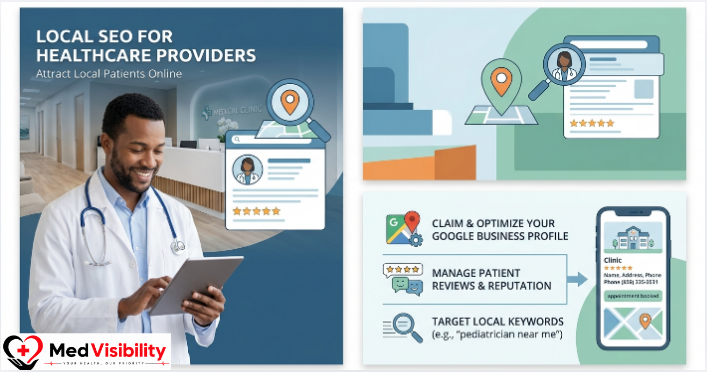
Local SEO is the process of optimising your online presence so your practice appears when people nearby search for the services you offer think “dentist in Leeds,” “private GP near me,” or “physiotherapy for lower back pain [town].” how to manage local seo for healthcare providers?
It’s different from general SEO in one key way: intent and location both matter. Someone searching “symptoms of tennis elbow” wants information. Someone searching “physio for tennis elbow near me” wants an appointment, this week, close to home. Local SEO is built for that second kind of search the ones closest to a booking. how to manage local seo for healthcare providers?
For healthcare specifically, three things make this more demanding than local SEO for, say, a restaurant or a hair salon:
- Trust matters more. Google treats health-related searches as “Your Money or Your Life” (YMYL) content, meaning it holds medical and wellness pages to a higher accuracy and credibility bar than most other topics.
- Patients cross-check you. Before booking, most patients bounce between your Google Business Profile, your website, a review site, and sometimes a quick search of your name all before they call.
- Regulation shapes what you can say. In the UK, advertising rules from the ASA and CAP, along with guidance from bodies like the CQC and relevant professional colleges, constrain how practices can describe outcomes, qualifications, and services. how to manage local seo for healthcare providers?
None of that makes local SEO harder to start it just means the foundation has to be accurate, complete, and genuinely reflective of the care you provide, rather than stuffed with keywords.
Why Local SEO Matters More Than Ever in 2026
A few shifts have made local visibility non-negotiable for healthcare providers this year:
- Search has become fragmented. Patients move between Google Search, Google Maps, review sites, and increasingly AI tools like ChatGPT or Google’s AI Overviews before ever landing on a practice website. Being findable in all of those places — not just a traditional search results page — now determines whether you get considered at all.
- Google Business Profiles are doing more of the work. For many local searches, a patient can see your hours, services, reviews, and location without ever clicking through to your site. A thin or outdated profile quietly loses patients who never even realise they skipped you.
- Review recency counts more than review volume. A practice with 300 reviews from 2019 tends to be outranked today by one with 120 reviews and a steady flow of new ones. Google reads an active pattern of recent, positive reviews as a live signal of quality — not just a historical one. how to manage local seo for healthcare providers?
- AI-driven search is starting to recommend providers directly. When someone asks an AI assistant “who’s a good dentist near me,” the answer draws on the same signals — accurate listings, structured content, and third-party validation through reviews — that power traditional local rankings.
The upshot: local SEO isn’t a one-off project you finish and forget. It’s closer to an ongoing part of running the practice, the same way appointment scheduling or patient records are. how to manage local seo for healthcare providers?
The Foundation: Your Google Business Profile
If there’s one thing to prioritise above everything else in this guide, it’s this. Your Google Business Profile (GBP) is free, and it’s the single biggest lever most healthcare providers have for local visibility. It’s what populates the Local Pack, powers your listing on Google Maps, and fills the knowledge panel that appears when someone searches your practice name directly.
Most healthcare profiles are only half filled in — which means a fully completed one is often enough, on its own, to outperform nearby competitors. how to manage local seo for healthcare providers?
Get these right:
- Business name. Use your actual, registered practice name — not a name stuffed with keywords like “Best Dentist Manchester.” Google penalises this, and it can get your listing suspended.
- Categories. Choose the most accurate primary category (e.g., “Physiotherapist,” “General Practitioner,” “Dental Clinic”) and add relevant secondary categories for services you genuinely offer. This single field tells Google what kind of practice you are more than almost anything else.
- Address and service area. Make sure this is exact and matches your website and any directories you’re listed on. how to manage local seo for healthcare providers?
- Hours, including holiday hours. Incorrect hours are one of the fastest ways to lose a patient’s trust before they’ve even called. how to manage local seo for healthcare providers?
- Services section. List your actual treatments and procedures here, in the profile’s own fields — not just buried on your website. This is searchable data Google uses directly. how to manage local seo for healthcare providers?
- Photos. Profiles with genuine photos of the practice, team, and reception area consistently get more calls and direction requests than those without. how to manage local seo for healthcare providers?
- Business description. A clear, plain-English summary of who you are, what you treat, and where you’re based — written for a patient, not an algorithm. how to manage local seo for healthcare providers?
- Q&A and messaging. Keep an eye on the public Q&A section (anyone can post a question), and enable messaging if you can respond promptly. how to manage local seo for healthcare providers?
Once your profile is complete, treat it like a living page. Post updates when you add a service, change hours, or want to highlight something seasonal (flu clinics, for example). Some practices now see more traffic on their Google Business Profile than on their actual website — which tells you where the attention already is.
NAP Consistency: The Detail Everyone Underestimates
NAP stands for Name, Address, and Phone number, and it needs to match — exactly — everywhere your practice appears online: your website, your Google Business Profile, health directories, insurance provider listings, and local citation sites.
That means “St. James Medical Practice” and “St James Medical Centre” need to be reconciled into one consistent version. “0161 xxx xxxx” shouldn’t appear as “+44 161 xxx xxxx” on one site and the local format on another. It sounds pedantic, but search engines use NAP consistency as a trust signal — inconsistent data makes your practice look less reliable, and it genuinely confuses patients trying to call the right number.
A simple audit process:
- List every place your practice appears online — website, GBP, directories, insurer listings, review sites, local press mentions.
- Record the NAP details exactly as shown on each.
- Pick one authoritative version of your name, address, and phone number.
- Update every listing to match, starting with the highest-traffic ones (Google, then major directories).
- Set a recurring reminder — quarterly is reasonable — to recheck, since directories update independently and drift happens. how to manage local seo for healthcare providers?
Location and Service Pages That Actually Help Patients
If you operate from a single site, you still benefit from a well-built “Contact & Location” page with a clear description of who you serve. If you have multiple locations, each one needs its own dedicated page — not a shared page with a dropdown, and not the same paragraph copy-pasted across each location with the town name swapped. how to manage local seo for healthcare providers?
A strong location page typically includes:
- The specific address, parking information, and public transport notes
- A short, genuine description of that location (team, specialties available there, anything distinctive)
- An embedded map how to manage local seo for healthcare providers?
- Location-specific reviews, where possible
- Clear next steps: how to book, call, or find directions
A strong service page does something similar for a treatment or specialty — for example, a dedicated page for “knee physiotherapy” rather than folding it into a general “our services” list. Written well, it answers the questions a patient searching that term actually has: what the condition involves, what treatment looks like in practice, roughly what to expect, and how to book — without drifting into diagnostic claims or guaranteed outcomes. how to manage local seo for healthcare providers?
Patient Reviews: Volume, Recency, and How to Ask
Reviews influence two different things at once: how Google ranks you locally, and whether a patient who finds you actually books. Both respond more to recent, ongoing reviews than to a large historical total.
A sustainable approach:
- Build a simple, consistent process for asking satisfied patients to leave a review — a short text or email link after a positive visit works well, timed close to the appointment while it’s fresh.
- Never offer payment, discounts, or incentives for reviews. Beyond breaching Google’s policies, incentivised reviews can also raise concerns under advertising standards for healthcare marketing.
- Respond to reviews — positive and negative — professionally and promptly. A calm, helpful response to a critical review often reassures future patients more than the review itself concerns them.
- Never confirm a patient’s treatment, condition, or visit details in a public review response. This is both a confidentiality and, depending on what’s said, a data protection issue.
- Monitor reviews across the platforms patients actually use for healthcare, not just Google — many patients check condition– or specialty-specific directories too. how to manage local seo for healthcare providers?
Content and E-E-A-T: Why Google Holds Health Sites to a Higher Bar
Google evaluates health content using what it calls E-E-A-T: Experience, Expertise, Authoritativeness, and Trustworthiness. For YMYL topics like medical advice, this isn’t a minor ranking factor — it’s central to whether your content is trusted at all. how to manage local seo for healthcare providers?
In practice, that means: how to manage local seo for healthcare providers?
- Attribute content to a real person. A named author with relevant credentials, ideally with a short bio linking to their qualifications, does more for both patients and Google than anonymous copy.
- Consider a “reviewed by” note on clinical content. Having a qualified clinician review patient-facing content before publishing — and stating that plainly on the page — is one of the strongest trust signals a healthcare site can add.
- Cite credible sources. Where you reference guidance or statistics, link to recognised bodies such as the NHS, NICE, or peer-reviewed research, rather than presenting claims without any backing.
- Avoid absolute claims. Phrases like “guaranteed results,” “pain-free in days,” or “the best treatment for X” tend to read as overpromising, and can also brush up against ASA/CAP advertising rules for healthcare services.
- Keep information current. Medical guidance changes. A page that hasn’t been reviewed in three years, referencing outdated statistics, is a liability for accuracy as well as for rankings.
None of this replaces the judgement of a qualified clinician, and content written for a practice website should never present itself as personalised medical advice, diagnosis, or a substitute for an actual consultation.
Technical Basics That Support Local Rankings
Local SEO doesn’t live in isolation — a slow, broken, or hard-to-use website undermines everything above it.
| Area | What to check | Why it matters |
|---|---|---|
| Mobile usability | Site loads cleanly and is easy to navigate on a phone | Most local health searches happen on mobile, often on the go |
| Page speed | Pages load in a few seconds, images are compressed | Slow sites lose patients before the page even finishes loading |
| Schema markup | Medical-specific structured data (e.g., MedicalOrganization, Physician) is added where relevant | Helps Google understand and correctly display your practice details |
| Booking clarity | Phone number and booking link are visible without scrolling | Reduces friction between finding you and booking |
| Security | Site uses HTTPS | A baseline trust and ranking signal, and expected for any site handling patient enquiries |
| Directory presence | Listed accurately on relevant health directories | Reinforces NAP consistency and adds credible third-party signals |
Common Local SEO Mistakes Healthcare Providers Make
- Treating the Google Business Profile as “set and forget.” Left unmanaged, hours drift, categories go stale, and competitors with active profiles pull ahead.
- Duplicating location page content. Copy-pasted pages with only the town name changed read as thin content to Google and unhelpful to patients.
- Ignoring provider-level profiles. Optimising only the practice as a whole, while ignoring individual clinician listings and bios, misses a layer of trust signals patients specifically look for.
- Chasing review quantity over consistency. A slow, steady trickle of recent reviews outperforms a one-off push for a large batch that then goes quiet for years.
- Inconsistent NAP details across directories. Small mismatches accumulate and quietly erode both trust and rankings.
- Overpromising in marketing copy. Beyond the ranking risk, this can create real regulatory exposure under UK advertising standards for healthcare.
- No one owning the process. Local SEO tends to fail when it’s “everyone’s job,” which usually means it’s no one’s. A single named owner, even for an hour a month, keeps the basics from slipping.
How Long Does It Take to See Results?
There’s no honest way to promise a specific week or month — anyone guaranteeing a fixed timeline is worth treating with caution. That said, a reasonable, commonly observed pattern is measurable improvement within three to six months of consistent effort, starting with the foundation (profile completeness, NAP consistency, and a steady review flow) before layering in content and technical improvements.
Conclusion
Local SEO for healthcare providers isn’t about clever tricks or gaming an algorithm — it’s about making sure the accurate, useful information patients need to find and trust you is complete, consistent, and easy for both people and search engines to find. Start with the Google Business Profile, get your NAP details consistent everywhere, build honest location and service pages, and keep a steady flow of recent reviews. Everything else schema, content depth, AI visibility builds on that same foundation.
PEOPLE CAN ALSO READ THIS: How Online Marketing Works for Doctors 2026 Guide
FAQs
What’s the fastest way to improve local SEO for a healthcare practice?
Start with your Google Business Profile. Fill in every field — categories, services, hours, photos, and a clear description — since incomplete profiles are the most common and most fixable issue.
Do I need a separate page for each location?
Yes, if you operate from more than one site. Each location page should have unique, genuinely local content rather than a template with the town name swapped.
How many reviews does a healthcare practice need?
There’s no fixed number. A steady flow of recent, genuine reviews tends to outperform a large historical total that’s gone stale, so consistency matters more than hitting a specific count.
Is it against the rules to ask patients for reviews?
Asking is generally fine; incentivising reviews with payment or discounts isn’t, and can also raise advertising standards concerns in healthcare marketing. A simple, low-pressure request after a positive visit is the standard, low-risk approach.
Does local SEO affect how AI tools recommend healthcare providers?
Increasingly, yes. AI assistants and AI-generated search summaries draw on the same underlying signals — accurate business listings, structured content, and third-party validation through reviews — that traditional local search rankings rely on.
Can I manage local SEO myself, or do I need an agency?
Many of the foundational steps — completing your Google Business Profile, fixing NAP consistency, and building a simple review request process — can be done in-house with a few focused hours. Ongoing content, technical SEO, and multi-location strategy tend to benefit from specialist support, particularly for practices balancing this against clinical and compliance demands.
For more updates visit: medvisibility.co.uk

Other Articles
What Is Medlytics Medical Analytics, Simply Explained
How Online Marketing Works for Doctors 2026 Guide




[…] READ MORE: Local SEO for Healthcare Providers A Complete Guide […]
[…] in Google Search and Google Maps. It’s the place where you edit your business information, post updates, respond to reviews, and track […]