



Somewhere near you, right now, a patient is typing “dentist near me” or “GP accepting new patients” into their phone. They won’t scroll past the first few results. They almost certainly won’t call a practice they can’t find. That single moment search, scan, decide is where most healthcare providers quietly lose patients they never knew existed.
It’s also why so many clinics, dental practices, and multi-location health groups eventually start looking for a healthcare local SEO company rather than trying to manage search visibility themselves. The idea makes sense on paper. In practice, choosing the right partner is harder than it looks, because healthcare marketing carries stakes that a restaurant or retail shop simply doesn’t: patient trust, regulatory sensitivity, and Google’s famously strict standards for medical content.
This guide walks through what a healthcare local SEO company actually does, how it differs from general SEO, what to look for before signing a contract, and the questions worth asking before you commit a marketing budget to it.
A quick note before we start: this article is written to help you understand and evaluate local SEO services for a healthcare practice. It isn’t legal, financial, or regulatory advice, and any compliance questions (HIPAA, GDPR, or advertising standards in your region) should be confirmed with a qualified professional.
What Is a Healthcare Local SEO Company?
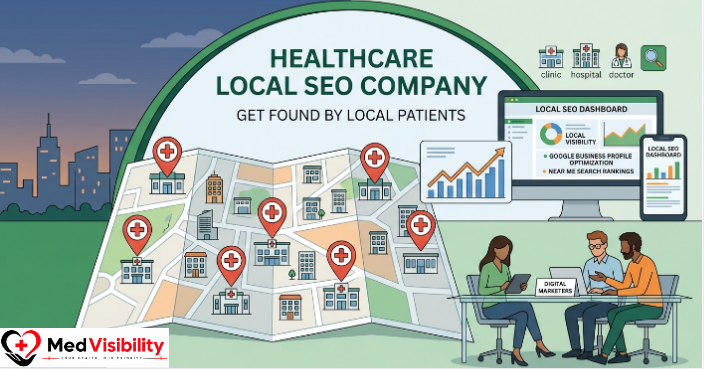
A healthcare local SEO company is a marketing agency that specialises in helping medical practices, clinics, hospitals, dental offices, and other healthcare providers rank higher in local search results — the map listings and “near me” results that appear when someone searches for care in a specific area.
This is different from general SEO in a few important ways: healthcare local seo company
- It focuses on proximity-based search intent. Someone searching “physiotherapist Manchester” wants a result within a reasonable distance, not the best physiotherapy content in the country.
- It understands healthcare-specific ranking factors. Google Business Profile categories, medical schema markup, provider-level listings, and healthcare directories (like NHS-linked listings in the UK, or Healthgrades and Zocdoc in the US) all play a role that generic SEO agencies often miss.
- It’s built around trust signals. Because medical information falls under what Google calls YMYL — “Your Money or Your Life” — content quality, accuracy, and credibility matter more here than in almost any other industry. healthcare local seo company
READ MORE: Local SEO for Healthcare Providers A Complete Guide
In short, a specialist agency treats your practice less like a local business and more like a trusted local resource that happens to compete in search results.
Why Local Search Matters So Much for Healthcare Providers
The shift toward “search first, call second” isn’t new, but it has accelerated. Independent research consistently finds that the vast majority of patients research a provider online before booking — checking reviews, comparing practices, and reading service pages — often before they’ve decided which condition or treatment they actually need.
A few dynamics make this especially true in healthcare: healthcare local seo company
- Reviews carry outsized weight. Patients weigh online reviews almost as heavily as a personal recommendation, particularly for choices that feel vulnerable, like a new GP, therapist, or specialist.
- “Near me” searches are high-intent. Someone searching “urgent care open now” or “paediatrician accepting NHS patients” is close to making a decision, not casually browsing. healthcare local seo company
- AI-powered search is changing the funnel again. Google’s AI Overviews and similar AI-assisted search experiences increasingly summarise a short list of recommended providers directly in the results, rather than showing a long list of map pins. That means visibility now depends not just on ranking, but on whether an AI system judges a practice credible enough to mention at all. healthcare local seo company
For a solo practitioner, this might mean the difference between a fully booked calendar and empty appointment slots. For a multi-location health group, it can mean the difference between growth and stagnation in specific markets.
What a Good Healthcare Local SEO Company Actually Does
Reputable agencies tend to work across several connected areas rather than offering a single fix. Here’s what that typically includes. healthcare local seo company
Google Business Profile Optimisation
Your Google Business Profile (formerly Google My Business) is often the very first thing a prospective patient sees. A specialist agency will typically: healthcare local seo company
- Confirm accurate business categories (e.g., “Paediatric Clinic” rather than the generic “Doctor”)
- Keep hours, holiday closures, and contact details current
- Add relevant attributes (wheelchair access, telehealth availability, languages spoken)
- Upload real photos of the practice, providers, and facilities healthcare local seo company
- Populate the Q&A section with genuinely useful answers to common patient questions
Citations and Listing Consistency
Your practice’s name, address, and phone number (often shortened to “NAP”) need to match exactly across every directory where it appears — Google, Bing, Apple Maps, health-specific directories, and general business listings. Inconsistent details are one of the quieter reasons practices lose local visibility, because they signal to search engines that the listing may not be trustworthy. healthcare local seo company
Review Generation and Management
Rather than simply asking for more reviews, a good agency builds a repeatable process: making it easy for satisfied patients to leave feedback, monitoring for anything that needs a thoughtful response, and ensuring the practice never appears to be ignoring patient concerns. healthcare local seo company
Local, Symptom-Aware Content
This is where healthcare local SEO diverges most from general SEO. Instead of generic service pages, a specialist agency writes content around how patients actually search — “knee pain treatment,” “flu testing near me,” “same-day dental emergency” — while keeping the language clear, accurate, and free of exaggerated claims. healthcare local seo company
Technical and Schema Markup
Structured data (schema markup) helps search engines understand exactly what a page is about — which provider works where, what conditions they treat, what insurance they accept. Done well, this also improves how a practice’s information appears in AI-generated search summaries.
Compliance-Aware Marketing
In regulated healthcare markets, a specialist agency should understand what can and can’t be claimed in marketing content, how patient data must be handled in tracking and forms, and how to avoid language that reads as a medical guarantee rather than general information.
DIY Local SEO vs. Hiring a Healthcare Local SEO Company
Not every practice needs to outsource this work immediately. The right choice usually depends on time, in-house expertise, and how competitive your local market is.
| Factor | Doing It Yourself | Hiring a Specialist Agency |
|---|---|---|
| Time investment | High — ongoing, weekly attention needed | Lower for your team, but requires oversight |
| Healthcare-specific expertise | Depends on who’s doing it | Built in, if the agency genuinely specialises |
| Cost | Lower direct cost, higher opportunity cost | Ongoing monthly investment |
| Compliance awareness | Risk of unintentional missteps | Should be part of the agency’s core offering |
| Speed of results | Often slower, especially in competitive areas | Can move faster with dedicated resources |
| Best suited for | Solo practitioners with light competition | Multi-provider practices, competitive markets, multi-location groups |
Neither column is automatically “right.” A single-provider practice in a low-competition area may do perfectly well handling the basics in-house. A multi-location group competing against well-resourced practices in a dense city will usually see a faster return from specialist help.
READ MORE: How Online Marketing Works for Doctors 2026 Guide
How to Choose the Right Healthcare Local SEO Company
Once you’ve decided to hire, the evaluation process matters as much as the decision itself. A handful of questions tend to separate agencies worth trusting from those simply reselling generic SEO packages with a healthcare label attached.
1. Do they have real healthcare experience?
Ask for case studies or examples specifically within healthcare — not just “local business” results. Healthcare SEO involves regulatory nuance, patient sensitivity, and search patterns that don’t map cleanly from, say, restaurants or law firms.
2. Do they understand YMYL and E-E-A-T?
Because medical content falls under Google’s strictest content-quality standards, ask how the agency approaches accuracy, sourcing, and author credibility. An agency that has never heard the term E-E-A-T (Experience, Expertise, Authoritativeness, Trustworthiness) is unlikely to be equipped for healthcare content.
3. Are they realistic about timelines?
Local SEO is not instant. Be cautious of any agency promising guaranteed first-page rankings within days or weeks — that’s a claim no one can make honestly, given how search algorithms work.
4. How do they report results?
Ask what you’ll actually see: rankings, but also calls, form submissions, appointment requests, and review growth. Traffic numbers alone don’t tell you whether new patients are actually booking.
5. Do they understand your compliance environment?
Whether that’s HIPAA in the US, GDPR and advertising standards in the UK, or other regional regulations, a credible agency should be able to explain — in plain terms — how they handle patient data collected through forms, tracking, and chat tools.
6. Is pricing transparent?
Reasonable agencies explain what’s included, what isn’t, and why. Vague, all-inclusive pricing with no breakdown is worth questioning.
READ MORE: How to Choose the Right Medical Digital Marketing Company in 2026
Red Flags to Watch For
A few warning signs are worth taking seriously during the evaluation process:
- Guaranteed rankings. No legitimate agency can guarantee a specific ranking position — Google’s algorithm isn’t something any outside company controls.
- Generic proposals. If a pitch reads like it was copy-pasted for every industry, it probably was.
- No mention of patient trust or compliance. If the conversation never touches on regulatory sensitivity, that’s a sign healthcare isn’t really their focus.
- Vague reporting. “We’ll send monthly updates” without specifics on what those updates measure is a common way agencies avoid accountability.
- Pressure to sign quickly. Reputable agencies are comfortable with a practice taking time to compare options.
What Does Healthcare Local SEO Typically Cost?
Pricing varies significantly by market size, competition, and scope of work, and any specific number should be treated as a general range rather than a quote. Independent solo practices often see monthly local SEO investments in the low-to-mid hundreds of pounds or dollars, while multi-location groups or highly competitive specialties can run considerably higher, particularly when content creation, technical work, and reputation management are all included.
The more useful question isn’t “what’s the cheapest option,” but “what’s the realistic cost of not being found by patients who are already searching for care nearby?”
Signs Your Practice Might Need a Local SEO Company
Much like recognising when a health symptom needs professional attention rather than home care, there are practical signs that a practice’s search visibility needs outside expertise rather than occasional in-house effort:
- New patient inquiries have plateaued or declined, despite steady care quality
- Competing practices consistently outrank you for your core services
- Your Google Business Profile hasn’t been updated in months
- You’re opening a new location and need visibility from day one
- Review volume or quality has stagnated compared to nearby competitors
- Your team simply doesn’t have the time or expertise to manage this consistently
If two or three of these sound familiar, that’s usually a reasonable point to start evaluating agencies rather than continuing to handle it piecemeal.
Key Takeaways
- A healthcare local SEO company specialises in helping medical practices rank in location-based search results, combining local SEO fundamentals with healthcare-specific trust and compliance considerations.
- Local search matters more in healthcare than in most industries, because patient decisions are high-stakes and heavily influenced by reviews and search visibility.
- Not every practice needs to outsource immediately — the right choice depends on competition, in-house resources, and growth goals.
- Evaluate agencies on healthcare experience, transparency, realistic timelines, and understanding of compliance — not just price.
- Be cautious of guaranteed rankings, generic proposals, or vague reporting.
- AI-powered search is changing how visibility works, rewarding consistent, accurate, well-structured information.
The Bigger Picture: Local SEO in the Age of AI Search
Search itself is changing faster than most healthcare marketing has caught up with. AI Overviews and AI-assisted answers are increasingly deciding, before a patient even scrolls, which local providers are worth mentioning. That shift rewards practices with consistent, accurate, well-structured information across the web — and quietly penalises those with outdated listings, thin content, or inconsistent details scattered across directories.
READ MORE: Medical Digital Marketing Agency UK A Practical Guide
This is part of why the “local familiarity” that once defined a good local SEO partner isn’t quite enough anymore. The agencies doing this well in 2026 combine traditional local SEO fundamentals with an understanding of how AI search systems evaluate credibility — which, in healthcare, comes back to the same core idea Google has pushed for years: real expertise, real trust, real accuracy.
FAQs
What’s the difference between local SEO and general SEO for healthcare?
Local SEO focuses on ranking for searches tied to a specific geographic area — “near me” and city-specific searches — while general SEO targets broader visibility that isn’t location-dependent. Most healthcare practices need local SEO as the priority, since most patients search for care close to home.
How long does it take to see results from healthcare local SEO?
Most agencies and independent research suggest initial movement within three to six months, with more substantial results building over six to twelve months. Timelines vary based on competition, starting point, and consistency of the work.
Can a general marketing agency handle healthcare local SEO effectively?
Some can, but healthcare carries unique considerations — regulatory sensitivity, YMYL content standards, and patient trust factors — that a specialist is more likely to understand deeply. It’s worth asking directly about their healthcare-specific experience before assuming general expertise transfers.
Is local SEO worth it for a solo practitioner?
Often, yes — particularly in competitive areas. Even modest improvements to a Google Business Profile and review management can meaningfully increase new patient inquiries, sometimes without a large ongoing budget.
Do healthcare local SEO companies handle Google Business Profile suspensions or issues?
Reputable agencies should be able to help resolve profile suspensions, duplicate listings, or verification issues, since these problems can quietly remove a practice from local search entirely until fixed.
How do I know if an SEO company understands healthcare compliance?
Ask directly how they handle patient data collected through website forms and tracking tools, and how they approach claims made in marketing content. A credible agency will have clear, specific answers rather than vague reassurances.
For more updates visit: medvisibility.co.uk

Other Articles

Legal Medical Digital Marketing in New York A Practical Guide
What Is Medlytics Medical Analytics, Simply Explained




[…] Google and Meta apply their own restrictions to health-related advertising, and these change often enough that it’s worth checking current policy before each campaign. Broadly, […]
[…] should speak to a GP or qualified healthcare professional, rather than relying on general information like this article, if: mounjaro nhs […]
[…] online forms should not be treated as a replacement for emergency […]
[…] health-food products. Most of the useful foods are available from ordinary UK supermarkets and local […]