



Most doctors didn’t train for years in medicine only to end up wondering why their clinic isn’t showing up on Google. Yet that’s exactly where a lot of GPs, consultants, dentists, and private practice owners find themselves fully booked with referrals a decade ago, and now quietly watching patient numbers plateau while a newer clinic two streets over seems to be everywhere online.
That gap usually isn’t about the quality of care. It’s about visibility. A patient today rarely picks a doctor the way their parents did through a phone book or a GP’s paper referral alone. They search. They read reviews. They check a website on their phone while sitting in a waiting room somewhere else. If a practice isn’t part of that search, it’s invisible to a large share of the people who need it, no matter how good the care behind the door actually is. how online marketing works for doctors.
This guide breaks down, in plain language, how online marketing actually works for doctors what it includes, what it doesn’t, what’s worth the investment, and what to be cautious about, especially given how healthcare advertising is regulated. It’s written for practising doctors, clinic owners, and practice managers who want to understand the landscape before hiring an agency or attempting it themselves.
What “Online Marketing for Doctors” Actually Means
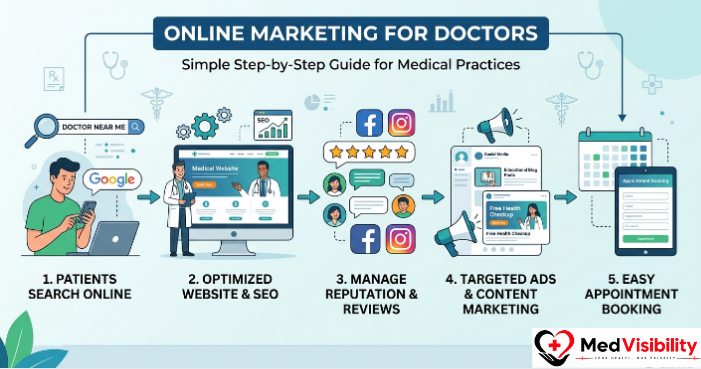
Online marketing for doctors is the set of digital activities a medical practice uses to become findable, trustworthy, and easy to choose for the patients searching for care. It’s not one tool it’s a combination of several, working together over time. how online marketing works for doctors.
At its core, it usually includes:
- A website that loads quickly, works on mobile, and clearly explains services, location, and how to book
- Search engine optimisation (SEO), so the practice appears when someone searches for a condition, treatment, or “doctor near me” how online marketing works for doctors.
- Google Business Profile management, which controls how a practice shows up in local map results
- Patient reviews and reputation management, since most people check reviews before booking
- Content marketing, such as blog articles or FAQs that answer common patient questions
- Paid advertising (Google Ads or social ads), used carefully and within advertising regulations
- Email or SMS communication, for appointment reminders, follow-ups, and patient retention
- Social media presence, mainly for trust-building and community visibility rather than hard selling
READ MORE: Medical Digital Marketing Agency UK A Practical Guide
None of these work particularly well in isolation. A beautiful website with no SEO strategy sits unseen. A strong Google ranking with no reviews or clear booking process doesn’t convert visits into appointments. The practices that do well online tend to treat these as one connected system, not a list of separate boxes to tick.
Why Doctors Can No Longer Rely on Word-of-Mouth Alone
Referrals and reputation still matter enormously in medicine, and that isn’t changing. But the way patients discover a doctor before that reputation ever reaches them has shifted. how online marketing works for doctors.
Consider a fairly ordinary patient journey in 2026: someone develops persistent back pain. Their first move isn’t calling a friend for a recommendation — it’s opening their phone and typing “back pain specialist near me” or “do I need a doctor for lower back pain.” They land on a search results page filled with clinic websites, health information articles, map listings, and, increasingly, an AI-generated summary at the top of the page pulling from a handful of trusted sources. how online marketing works for doctors.
If a local practice’s website doesn’t appear anywhere in that process — not in the map pack, not in the organic results, not cited in the AI summary — that patient will likely book with whichever clinic is visible, even if it isn’t objectively the better option. Visibility, in a very real sense, has become part of access to care.
This matters more, not less, as search itself changes. Google’s May 2026 core update and its expanding AI-driven search features (AI Overviews and AI Mode) have shifted how results are ranked and displayed, rewarding sites that demonstrate clear expertise, real-world experience, and trustworthy sourcing — while pushing thin, generic, or copy-paste content further down. For doctors, this is actually good news: genuine clinical expertise, properly presented, is exactly what these systems are designed to surface.
The Core Building Blocks of Doctor Marketing
1. A Website That Works Like a Digital Front Door
A medical website’s job is simple to state and harder to execute well: help a worried or curious visitor quickly understand who you are, what you treat, and how to book — without friction. how online marketing works for doctors.
Key elements that matter most:
- Clear service pages for each condition or treatment area, written in plain language
- Doctor bios with real qualifications, experience, and a photo — this builds trust fast
- Fast loading speed and mobile responsiveness, since most searches now happen on phones
- An obvious, simple way to book — a phone number, online booking form, or both, visible without scrolling
- Accessibility basics, like readable font sizes and good colour contrast, which also affect SEO
A common mistake is a website built purely to look impressive rather than to be useful to a patient scanning it in under 30 seconds. If a visitor can’t tell what a practice treats and how to contact them within a few seconds, the website is quietly losing patients. how online marketing works for doctors.
2. Search Engine Optimisation (SEO)
SEO is how a website earns visibility in unpaid, organic search results. For doctors, this typically breaks down into three connected layers: how online marketing works for doctors.
Local SEO — optimising for searches like “dentist in Manchester” or “GP near me.” This relies heavily on an accurate, well-maintained Google Business Profile, consistent business information across the web (name, address, phone number), and genuine patient reviews. how online marketing works for doctors.
On-page SEO — making sure each page on the website is structured around the terms patients actually search for, with clear headings, useful content, and proper technical setup (things like page titles, meta descriptions, and structured data that helps search engines understand the content).
Content SEO — publishing genuinely helpful articles that answer real patient questions (“What are the early signs of type 2 diabetes?” or “How long does recovery from a hip replacement take?”). This is where E-E-A-T — Experience, Expertise, Authority, and Trust — matters most, since Google explicitly treats health content as YMYL (Your Money or Your Life), meaning it holds medical pages to a higher quality bar than most other topics. how online marketing works for doctors.
A practical note for doctors: this is one area where being the actual expert is a real advantage. A generic marketing writer can produce a blog post about diabetes symptoms, but content reviewed or written with input from a practising clinician tends to be more accurate, more trusted, and — increasingly — more likely to be surfaced by search engines that are actively trying to reward genuine expertise over generic content.
3. Google Business Profile and Local Listings
For most patients, the first real impression of a practice isn’t the website — it’s the Google Business Profile that appears in a map search, showing hours, reviews, photos, and a “Book” or “Call” button.
An unclaimed or poorly maintained profile is one of the most common — and easiest to fix — gaps in doctor marketing. Basic upkeep includes: how online marketing works for doctors.
- Verifying and fully completing the profile (services, hours, photos, categories)
- Keeping information accurate, especially opening hours and phone number
- Responding to reviews, both positive and negative, professionally
- Posting occasional updates (new services, holiday hours, health awareness campaigns)
4. Patient Reviews and Reputation Management
Reviews function as modern word-of-mouth. Most patients read several before booking, particularly for elective or private care. This doesn’t mean chasing five-star ratings aggressively or, worse, offering incentives for reviews — that’s against most platforms’ policies and can damage credibility if discovered. It means:
- Making it easy for satisfied patients to leave a review (a simple link or QR code after a visit)
- Responding calmly and professionally to negative reviews, without breaching patient confidentiality in the response how online marketing works for doctors
- Monitoring reviews across Google, and where relevant, platforms like Doctify or NHS-linked review systems in the UKhow online marketing works for doctors
5. Content Marketing
Content marketing, in a medical context, means publishing information that genuinely helps patients — before, during, and after they choose a doctor. This might include condition explainers, treatment overviews, recovery guides, or preventive health tips. how online marketing works for doctors
Done well, content marketing does three things at once: it improves SEO, it builds trust with patients who are researching before they book, and it positions the doctor or practice as a credible source of information rather than just a service provider. Done poorly — thin, generic, AI-generated text with no real medical oversight — it can actively damage trust and search visibility, particularly under Google’s current quality standards for health content. how online marketing works for doctors
6. Paid Advertising
Paid search and social ads can help a new or growing practice get visibility faster than SEO alone, which tends to be a longer-term investment. Google Ads, for instance, can put a practice at the top of search results for high-intent terms like “private dermatologist consultation.”
However, healthcare advertising carries real regulatory weight. In the UK, marketing for doctors must comply with: how online marketing works for doctors.
- The General Medical Council (GMC)‘s guidance on promoting a doctor’s services, which requires marketing to be factual, verifiable, and not misleading
- The Advertising Standards Authority (ASA) rules on health-related advertising claims
- CAP and BCAP codes, which restrict exaggerated or unproven claims, particularly around cosmetic and aesthetic treatments how online marketing works for doctors
This is one area where working with someone who understands both marketing and healthcare advertising regulation matters. A campaign that promises results a treatment can’t reliably deliver isn’t just an ethical problem — it’s a compliance risk. how online marketing works for doctors.
7. Email, SMS, and Patient Retention
New patient acquisition tends to get the most attention, but retaining existing patients and encouraging follow-through (rebooking a check-up, attending a screening, completing a treatment plan) is usually more cost-effective. Simple, well-timed communication — appointment reminders, post-visit check-ins, seasonal health reminders — keeps a practice present in a patient’s life without being intrusive. how online marketing works for doctors.
How These Pieces Work Together
| Marketing Channel | Main Purpose | Typical Timeline to See Results |
|---|---|---|
| Website optimisation | First impression, conversion | Immediate to a few weeks |
| Local SEO / Google Business Profile | Local visibility, map pack ranking | 1–3 months |
| Organic SEO / content marketing | Long-term search visibility | 3–12 months |
| Reviews & reputation management | Trust and conversion | Ongoing |
| Paid advertising | Fast, short-term visibility | Immediate, but stops when spend stops |
| Email/SMS communication | Patient retention | Ongoing |
The table above is a useful way to see why doctors often feel frustrated by marketing: SEO and content, which tend to deliver the most durable results, are also the slowest to show up. Paid ads deliver quick visibility but disappear the moment the budget does. A realistic strategy usually blends a short-term channel (ads, or an optimised Google Business Profile) with a long-term one (SEO and content), rather than relying on just one.
What Makes Doctor Marketing Different From Marketing Other Businesses
A few things set healthcare marketing apart from marketing a restaurant or a retail shop, and they’re worth understanding before choosing an agency or approach. how online marketing works for doctors.
Regulatory constraints are real and specific. Testimonials about clinical outcomes, before-and-after images for certain procedures, and claims about treatment success rates are all restricted or prohibited depending on the jurisdiction and medical specialty. What’s standard practice in general marketing can be a compliance issue in healthcare marketing. how online marketing works for doctors.
Trust matters more than persuasion. Patients aren’t choosing between two similar consumer products; they’re choosing who treats their body or their child’s health. Marketing that feels like a hard sell tends to backfire, while marketing that feels like clear, honest information tends to build confidence.
Accuracy carries higher stakes. A factual error in a blog post about, say, when to seek emergency care isn’t just a content quality issue — it’s a patient safety issue. This is part of why Google treats medical content as YMYL and applies stricter quality signals to it.
Search engines are watching for genuine expertise. Since the most recent core updates, generic or AI-drafted health content with no clinical review is increasingly filtered out of top results, in favour of content that shows real experience and credible authorship — good news for practices willing to invest in properly reviewed content, and a growing problem for those relying on cheap, mass-produced text.
Common Mistakes Doctors Make With Online Marketing
- Treating the website as a one-time project. A site built five years ago and never updated tends to fall behind both technically and in search rankings.
- Ignoring the Google Business Profile. It’s often the single highest-impact, lowest-cost thing a practice can maintain properly.
- Buying reviews or using incentives. This violates platform policies and, if discovered, damages credibility far more than a handful of average reviews would.
- Publishing content with no clinical input. Generic AI-written health articles, with no expert review, tend to underperform in search and can misinform patients.
- Running ads without understanding advertising regulations. This risks both wasted spend and, in more serious cases, regulatory complaints.
- Expecting instant results from SEO. SEO is a compounding investment, not a quick fix — practices that abandon it after a few months rarely see the full return.
When to Get Professional Help
Some parts of online marketing — claiming a Google Business Profile, asking happy patients for reviews, keeping a website’s information current — are manageable in-house with a bit of time. Others, particularly technical SEO, regulated advertising, and content strategy across a competitive local market, tend to benefit from experienced support, especially for practices with limited administrative time or multiple locations.
A reasonable signal that it’s time to bring in outside expertise: if a practice has a website but no clear sense of how many new patients it generates, or if competitors consistently outrank it for obvious searches, that’s usually a sign the current approach isn’t being actively managed rather than a sign that marketing “doesn’t work” for medical practices.
The Bottom Line
Online marketing for doctors isn’t about chasing trends or turning a medical practice into something it isn’t. At its core, it’s about making sure that when someone is searching for the kind of care a practice provides, they can actually find it clearly, accurately, and quickly. The building blocks (a solid website, local SEO, an active Google Business Profile, honest reviews, and carefully regulated advertising) work best as a connected system built over time, not a single quick fix.
For most practices, the practices that keep patients coming aren’t the ones chasing every marketing tactic they’re the ones that get the fundamentals right and keep them well-maintained.
FAQs
Is online marketing worth it for a small or single-doctor practice?
Often, yes — particularly local SEO and Google Business Profile optimisation, which are relatively low-cost and directly affect whether nearby patients can find the practice at all. The scale of investment can grow with the practice, but the basics are worth doing regardless of size.
How long does it take to see results from SEO?
Most practices start seeing meaningful movement in local search visibility within one to three months, with broader organic search improvements typically building over six to twelve months. SEO is a compounding effort rather than an instant fix.
Can doctors advertise their services online in the UK?
Yes, but advertising must comply with GMC guidance and ASA/CAP advertising codes, which restrict misleading claims, certain testimonials, and unverified outcome promises — particularly for cosmetic and aesthetic procedures. Working with someone familiar with these rules reduces compliance risk.
Do patient reviews actually affect whether people book an appointment?
Yes — reviews are one of the most commonly cited factors patients report checking before choosing a doctor, particularly for private or elective care. Consistent, genuine reviews (not incentivised ones) tend to have the strongest impact on trust.
Is it safe to use AI tools to write medical content for a practice website?
AI tools can help draft content faster, but health content published without review by a qualified clinician carries both a patient-safety and an SEO risk, since search engines are increasingly filtering out unreviewed, generic health content. Any AI-assisted content should be fact-checked and reviewed by someone with relevant medical knowledge before publishing.
What’s the single highest-impact first step for a practice with no existing online presence?
Claiming and fully completing a Google Business Profile, paired with a simple, mobile-friendly website that clearly states services and how to book, tends to deliver the fastest and most reliable return before investing further in SEO or advertising.
For more updates visit: medvisibility.co.uk

Other Articles

Local SEO for Healthcare Providers A Complete Guide
Mental Health Safety Tips During Covid A Practical Guide




[…] 30 seconds of squat jumps followed by 30 seconds of walking on the spot, repeated for 15–20 minutes. That’s the basic shape of […]
[…] access representative, patient registrar, or admissions specialist—is a specialized healthcare administrative professional responsible for managing the end-to-end patient onboarding […]
[…] health, comparable in some studies to other well-known health risks. Strong relationships, by contrast, are one of the most consistently protective factors identified in mental health […]